

For early-stage B2B SaaS founders and teams, the initial thrill often comes from landing new logos. Each new customer feels like a victory — a validation of product market fit. Plus, your sales team loves to hit that new customer gong!
However, as your SaaS company matures and begins to scale, the dynamics of growth fundamentally shift. The relentless pursuit of new customers becomes increasingly expensive and challenging, giving way to a more potent, capital-efficient, and sustainable engine: expansion revenue.
The Inevitable Shift from New Logos to Expansion Revenue
In the early days, customer acquisition is paramount. But as you scale, the market for new, easily acquired customers shrinks, and the cost of acquiring each new logo rises. Suddenly, the focus shifts from simply growing your customer base to growing the value of your existing customer base.
Our SaaS benchmarks indicate a clear trend: as companies scale, expansion ARR becomes an increasingly larger portion of total revenue. For example, expansion revenue (revenue from existing customers) makes up 23% of total revenue for SaaS companies with $1-5M ARR. For companies $5-20M ARR, expansion revenue jumps to 34% of total revenue. This trend continues as companies get bigger: Expansion revenue makes up 40% of total revenue for SaaS companies $20-50M, and once you get to companies with over $50M ARR, expansion revenue actually surpasses revenue from new customers entirely!
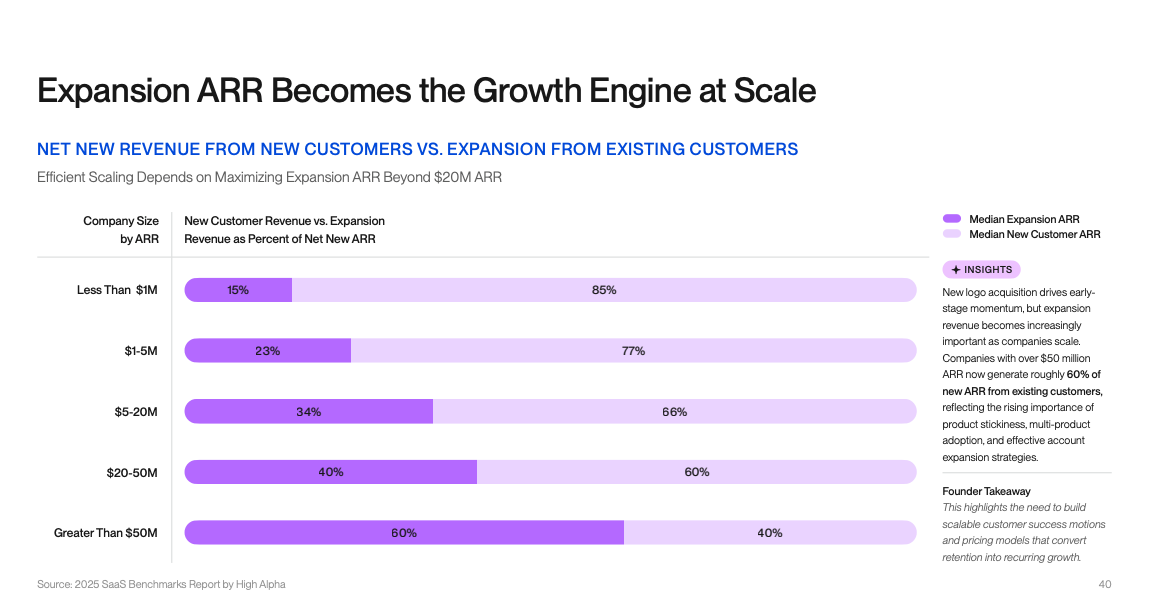
This isn't merely anecdotal; it's a fundamental truth for scaling SaaS. Why? Because an existing customer already trusts you, understands your value proposition, and has integrated your solution into their workflow. Selling them more — be it additional seats, new features, or entirely new products — is significantly more efficient than acquiring a brand-new customer. This cultivated customer base becomes a compounding asset, driving predictable, high-margin growth that’s crucial for achieving and maintaining a strong Rule of 40 performance and attractive valuations.
How Pricing Models Impact Growth and Retention
There are a few key levers to play with when thinking about growing expansion revenue. One of those levers? How you price your products.
Your pricing model isn't just about how much you charge initially; it's a strategic lever for continuous growth. The goal is to design a model that naturally encourages customers to expand their usage and investment as they get more value from your product. This means moving beyond rigid, flat-rate subscriptions to more dynamic approaches.
Lucky for you, we have some data that supports how different pricing models affect growth rates and net revenue retention (NRR).
According to our SaaS Benchmarks Report, variable pricing models (consumption-based, outcome-based, and hybrid pricing that combines variable pricing with subscription-based pricing) outperformed subscription pricing when looking at year-over-year growth.
SaaS companies adopting outcome-based pricing appeared to grow the fastest, at 65% year-over-year growth, followed by companies using consumption-based pricing who grew at 43% year over year. Companies with hybrid pricing models grew 40% year over year, and those with subscription-based pricing grew 34% year over year.
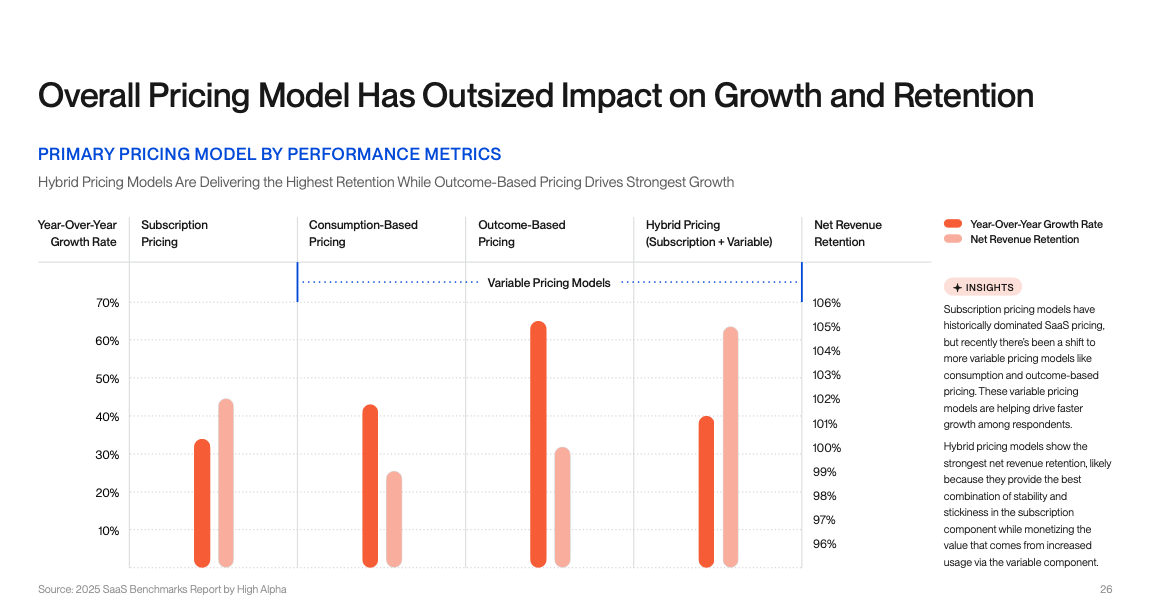
But, as we’re talking about expansion revenue, which goes hand in hand with NRR (the percentage of recurring revenue retained from existing customers over a specific time including upsells and churn), you’ll see that those with hybrid pricing are performing the best, with an NRR of 105%. Companies with subscription pricing on average had an NRR of 102%, companies with outcome-based pricing had an NRR of 100%, and companies with consumption-based pricing had an NRR of 99%.
So, how can this data help founders understand pricing models and expansion revenue?
In conclusion: Hybrid pricing models show the strongest NRR, likely because they provide the best combination of stability and stickiness in the subscription component while monetizing the value that comes from increased usage via the variable component. That said, expansion revenue is not simply unlocked through pricing models, but rather pricing models combined with packaging or product upsell opportunities.
The Sweet Spot: Optimizing for Mid-Range ACVs
While aiming for enterprise-level deals with seven-figure average contract values (ACVs) might seem tempting, for many scaling SaaS companies, particularly those focused on efficient growth and strong retention, optimizing for mid-range ACVs is the sweet spot. Our data shows that growth and retention performance converge in the mid-market — companies with ACVs between $10k and $100k show the strongest balance of scale and durability, with median year-over-year growth rates above 30%, gross revenue retention near or above 90%, and net revenue retention above 104%.
At the low end, smaller contracts are prone to churn and limited expansion. At the high end, growth slows as sales cycles lengthen and deal concentration rises.
Reported ACVs and Average Growth and Retention Metrics
To sum it up, a mid-range ACV (e.g., typically ranging from $10,000 to $100,000 annually, depending on your market) have a few unique qualities that allow for both growth and retention, including:
- Sufficiently Large for Value: It's high enough to warrant significant investment in customer success and product development, ensuring customers receive substantial value and are less prone to churn.
- Manageable Sales Cycle: It avoids the excessively long and complex sales cycles often associated with very large enterprise deals, allowing for faster velocity.
- Foundation for Expansion: A healthy initial ACV provides a solid base from which expansion revenue can compound significantly. A customer paying $20,000 annually has far more room and budget to expand their usage to $40,000 or $60,000 than a customer starting at $500k.
An ACV that is too low can lead to high churn sensitivity, making expansion efforts feel like trying to squeeze blood from a stone, while requiring an unsustainable volume of new logos to grow. An ACV that is too high might limit your addressable market and increase reliance on a few large accounts. Finding and optimizing for that mid-range ACV empowers you to build a robust customer base with significant expansion potential.
Fostering Multi-Product Adoption, Multi-Year Contracts, and Proactive Upsell
While pricing lays the groundwork, it's your sales, product, and customer success teams that actively cultivate the expansion goldmine.
For Customer Success (CS)
CS teams must evolve beyond reactive support to become proactive growth drivers.
- Deep Understanding and Discovery: Regularly engage with customers to understand their evolving needs, challenges, and goals. Uncover pain points that your existing (or soon-to-be-released) features can address.
- Value Realization and Education: Continuously demonstrate the value customers are already getting and educate them on additional capabilities they might not be fully utilizing.
- Proactive Upsell: Instead of waiting for customers to ask, CS should identify and proactively suggest relevant upgrades or complementary products. This requires a strong understanding of product capabilities and customer workflows.
For Sales Teams
- Negotiate Multi-Year Contracts Upfront: Long-term agreements shift the relationship from "should we renew?" to "how do we maximize value?" This stability provides the breathing room necessary for CS to drive adoption and for Sales to introduce new modules without the pressure of an imminent expiration date.
- Prioritize "Land and Expand" Structures: Avoid "overselling" a massive initial package that the customer isn't ready to use. Instead, land with a core solution and pre-negotiate "add-on" rates for future seats or features. This reduces initial friction and builds a repeatable expansion playbook.
- Bridge the CS-Sales Gap: Expansion revenue dies in the handoff. Sales should document the customer's "future state" — specifically identifying features the client expressed interest in but hasn't purchased yet — to give the CS team a clear roadmap for future upsells.
For Product Teams
Product development plays a critical role in enabling expansion by designing for it from the ground up.
- Modular Architecture: Build products with clear, value-additive modules or features that can be offered as upgrades.
- Interoperability: Ensure new products or features seamlessly integrate with existing ones, making multi-product adoption frictionless.
- Clear Upgrade Paths: Design product tiers and features that naturally lead users from a basic offering to more advanced, higher-value solutions as their needs mature.
- In-Product Triggers and Education: Embed guides, notifications, or prompts within the product that highlight premium features or complementary products when a user encounters a specific use case or hits a usage limit.
The Future Is Expansion
As you scale your B2B SaaS venture, remember that sustainable growth isn't just about who you acquire. It is about how deeply you serve and grow with your existing customers.
Mastering expansion revenue is the untapped goldmine for your business. It requires a mix of intelligent pricing, proactive customer success and sales, and thoughtful product development. When combined with optimized ACVs, these levers will fuel your journey far beyond initial traction — driving the efficient, predictable, and compounding growth you need for years to come.
