
Some companies start with a pitch deck.
Others start with a problem that refuses to go away.
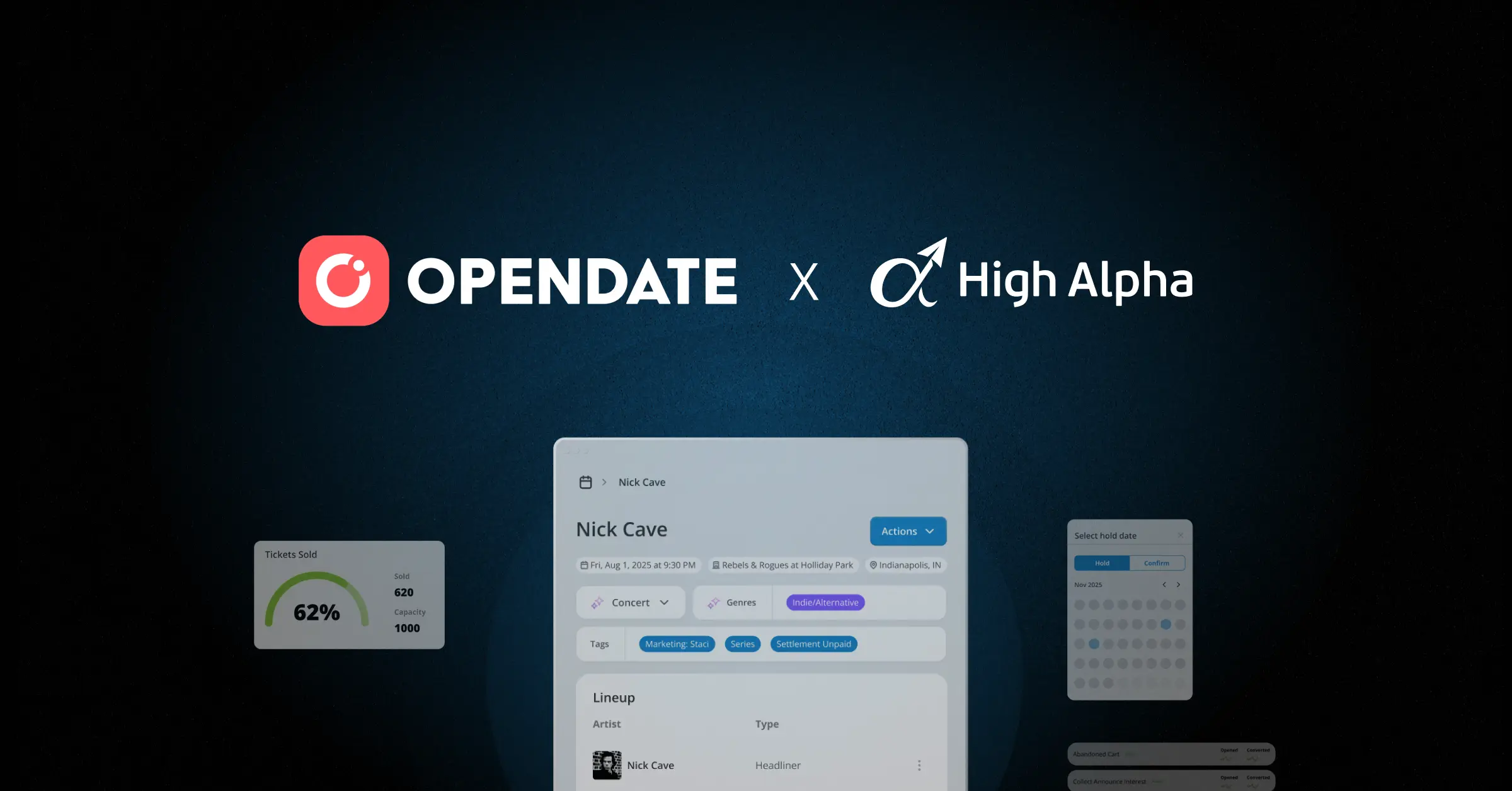
Opendate started because running an independent music venue is far harder than it should be. And today, we couldn’t be more excited to share our investment in their Series A funding.
Why We Invested in Opendate
If you know my longtime friend Eric Tobias, it probably won’t surprise you that Opendate was born from the front lines of the live music industry. Eric is a builder by instinct, but he’s also deeply curious about how real businesses actually work. Over the years, one of his passions became the live music industry. He’s a co-owner of The Vogue in Indianapolis, a historic venue with decades of shows, artists, and memories — and all the operational complexity that comes with it.

Ticketing. Artist settlement. Marketing. Promotions. Financial reconciliation. None of it was designed with the independent venue in mind.
So Eric did what many great founders do before they realize they’re founders: he tried to solve his own problem.
What began as a side project to support The Vogue — and his production company, Forty5 — slowly turned into something more. The software worked. Other venues asked for it. Word spread. And before long, Opendate was serving live music venues across the country.
Today, Opendate supports more than 150 independent venues and event operators. But what matters more than the number is how it got there.
Walking in the Shoes of Venue Operators
Like many strong software businesses, the software didn’t come first.
The work came first.
Eric spent years living inside the day-to-day reality of venue operators — booking artists, promoting shows, settling payments, and trying to make the economics work in a business that is both cultural and operationally unforgiving. Opendate reflects that lived experience. It’s not software built in search of a workflow; it’s software that absorbed the workflow and simplified it.
The platform brings together ticketing, event management, marketing, and financial settlement into a single operating system. Venues can book an artist, promote the event, sell tickets, and settle the show — all in one place. Using a ticket-fee model familiar to the industry, Opendate replaces a patchwork of tools with something cohesive and purpose -built.
Founder Market Fit Perfection
At High Alpha, one of the questions we ask when investing early is simple but demanding: Was this founder put on the planet to build this company?
It’s our shorthand for founder-market fit at its highest level.
Many of us on the High Alpha team have known Eric for nearly two decades. We’ve seen him as an operator, a leader, and a builder. Opendate sits at the intersection of his experience in software, his ownership and operational knowledge of live music venues and events, and his instinct for simplifying complex systems. It’s hard to imagine a more natural alignment.
We’re thrilled to lead Opendate’s next chapter and to support Eric and the team as they scale a platform built for a segment of the market that truly needs it.
The companies that win in every technology wave tend to follow a familiar pattern. They don’t chase abstraction for its own sake. They start with customers. They solve real problems. And they introduce technology in ways the market is actually ready to adopt.
Opendate is doing exactly that — and we’re excited to be along for the ride.
