

For early-stage SaaS founders, building a successful company is often a tightrope walk between growth and profitability. Throw AI into the mix (both internal adoption and product integration costs, alongside potential productivity gains and growth opportunities), and walking this tightrope has become even more challenging.
To understand the balance between growth and profitability, SaaS founders and leaders have looked to the Rule of 40 metric — and with good reason. As AI transforms the industry and many things change, some do not. In 2026, Rule of 40 remains an important SaaS benchmark to guide companies towards a harmonious blend of expansion and financial health.
Decoding the Rule of 40 for Software Companies in 2026
The Rule of 40 dictates that a SaaS company's growth rate percentage plus its profit margin percentage should equal or exceed 40%. While often associated with more mature companies, its principles are also relevant for early-stage startups — it encourages founders to think holistically about their business model from day one.
So, how did SaaS companies do in 2025? Let’s take a look.
On Average, Most SaaS Companies Fall Short of the Rule of 40
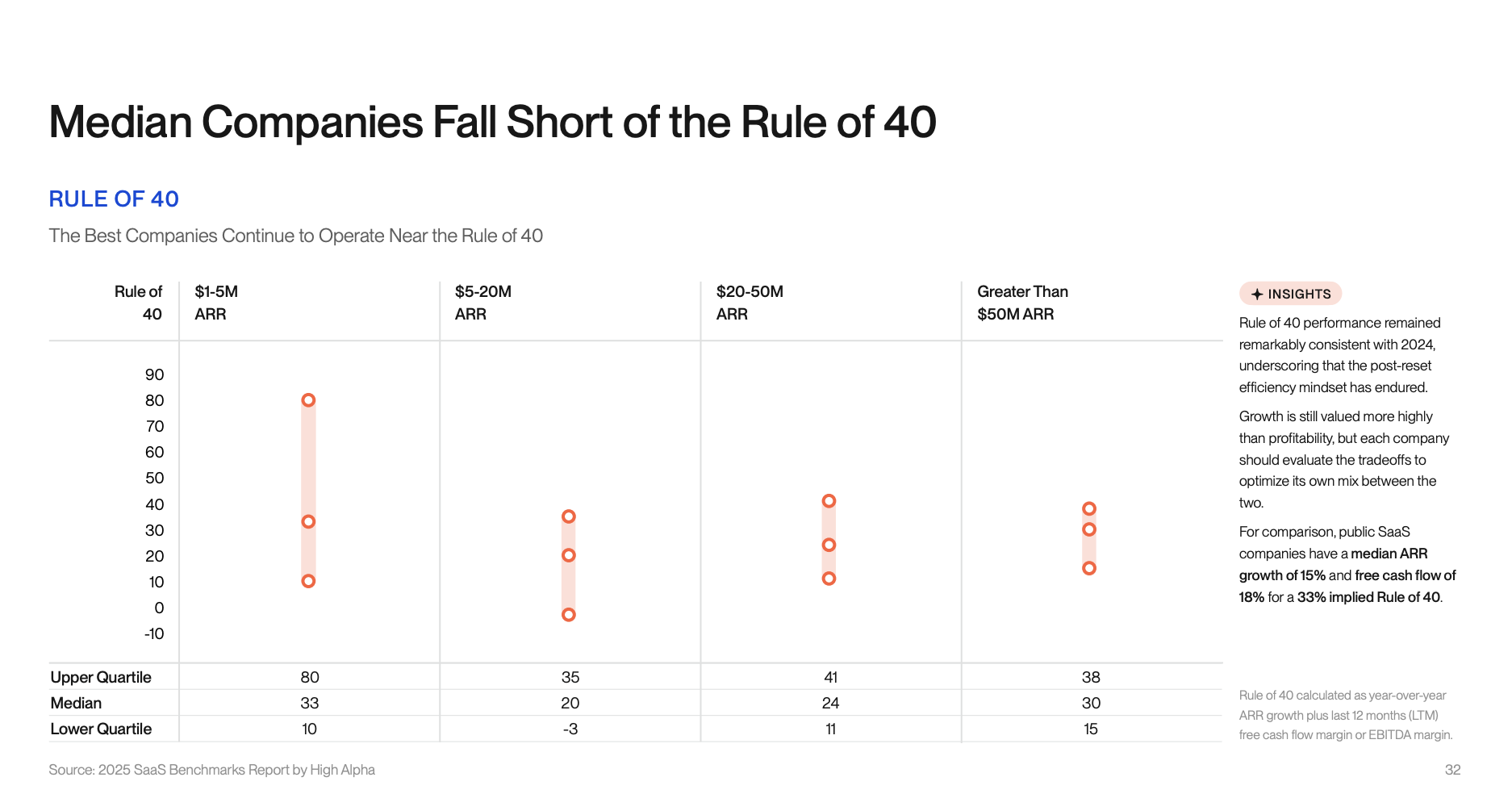
According to the 2025 SaaS Benchmarks Report, the median Rule of 40 percentage across all ARR bands was under the target of 40%. Median Rule of 40 for startups in 2025:
- 33% for companies $1-5M ARR
- 20% for companies $5-20M ARR
- 24% for companies $20-50M ARR, and
- 30% for companies >$50M ARR
When you look at benchmarks from the upper quartile, it’s a more positive story — all ARR cohorts are operating at or above 40%, give or take 5%. Upper quartile Rule of 40 for startups in 2025:
- 80% for companies $1-5M ARR
- 35% for companies $5-20M ARR
- 41% for companies $20-50M ARR, and
- 38% for companies >$50M ARR
Overall, Rule of 40 performance remained remarkably consistent with 2024, underscoring that the efficiency mindset of the past few years has endured. That being said, we’re entering the early innings of AI, which is starting to impact Rule of 40 and other SaaS benchmarks.
How AI Impacts Rule of 40 and Other SaaS Benchmarks
In addition to gathering benchmarks that help founders see how they stack up against competitors, we also wanted to understand whether costs associated with AI are negatively or positively impacting core metrics.
While it’s likely AI costs go down in the future, there’s been some concern about how the incorporation of AI into SaaS products could negatively affect margins, and therefore benchmarks like Rule of 40. It makes sense on paper: higher costs (due to AI) with similar growth rates lead to lower a Rule of 40. But, what we found in our data is that growth from AI-native companies (startups that reported AI as core to their products), outweighed the hit on margins — in short, it pays to be an AI-native company.
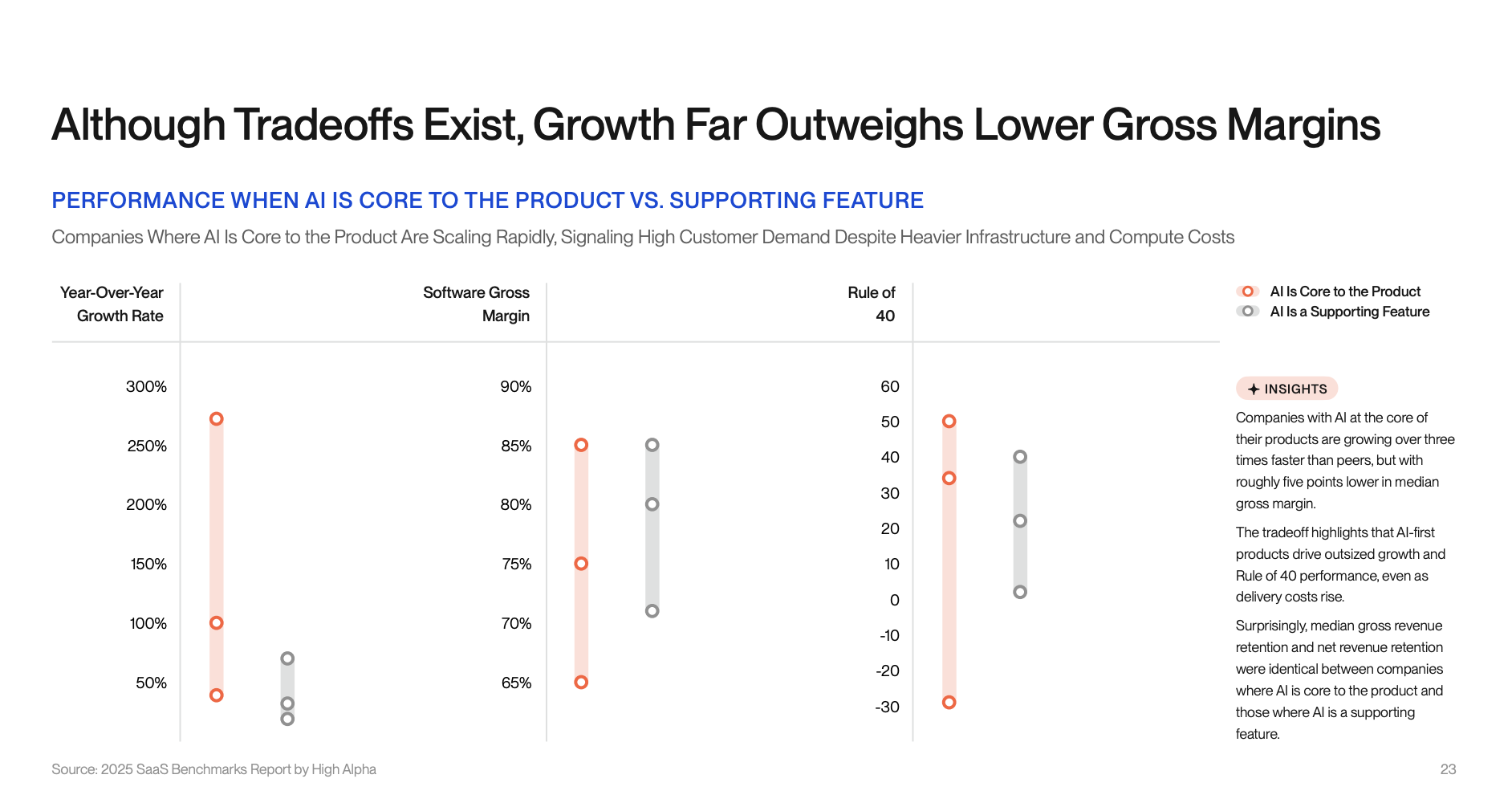
Regardless of whether you’re building an AI-native company or a more traditional SaaS startup, the key takeaway for early-stage founders isn't necessarily to achieve 40% immediately (though impressive if you do!), but rather to use it as a strategic framework. Are you investing heavily in growth that promises future returns? Or are you burning cash without a clear path to efficiency?
Strategies for Optimizing the Rule of 40
Optimizing the Rule of 40 in the early stages revolves around two core pillars: capital efficiency and disciplined growth.
Strong CAC + Retention Leads to Efficient Growth
There are many ways to improve capital efficiency (strategic resource allocation, adoption of AI internally to improve productivity, auditing and evaluating spend, etc.) and growth (a strategic GTM strategy, product innovation and expansion, etc.), but one of the most straightforward paths to efficient growth is improving two key metrics: net revenue retention (NRR) and customer acquisition cost (CAC).
The relationship between NRR and CAC remains one of the strongest predictors of SaaS performance. Companies that pair high NRR with low CAC deliver dramatically better outcomes — nearly doubling growth rates and Rule of 40 scores compared to peers with weaker retention or longer paybacks.
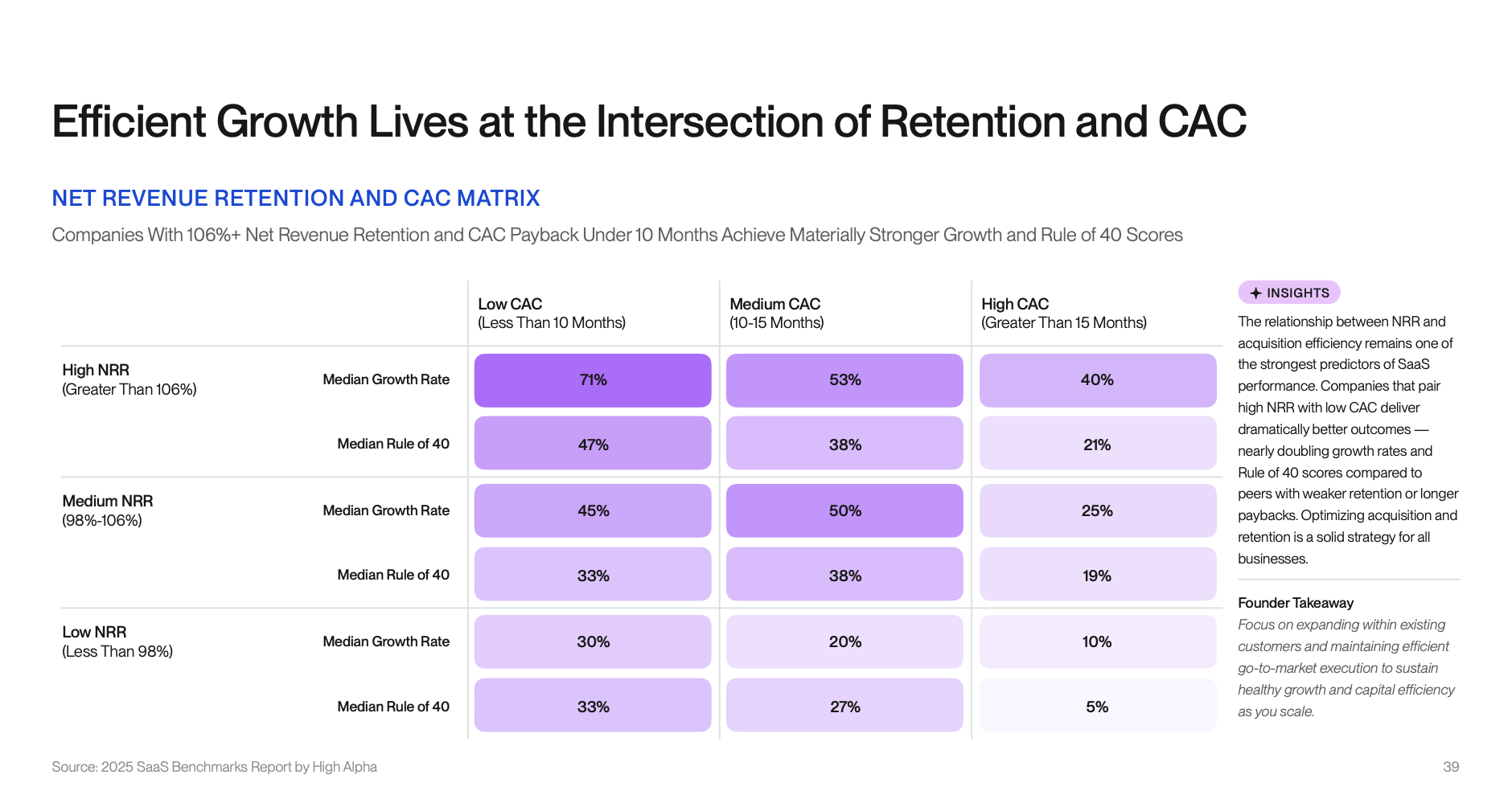
As you can see, SaaS companies that have an NRR higher than 106%, and a CAC that’s less than 10 months have a median growth rate of 71%, and a median Rule of 40 of 47%. Compare this to companies with a NRR that’s lower than 98% and a CAC that’s greater than 15 months and you get a median growth rate of 10%, and a median Rule of 40 of just 5%.
As we mentioned earlier, Rule of 40 is a good framework to use when balancing growth and capital efficiency. And, as the data shows, making progress against CAC and retention metrics can make a huge difference in your business.
Here’s how you can start.
When looking to improve CAC, focus on targeted market penetration. Instead of trying to be everything to everyone, focus on a more narrow ideal customer profile (ICP). Be specific. Even if your product can serve many different audiences, focus is key in the short term, and deep penetration in a smaller market can yield higher growth rates and better retention than shallow engagement across a broad spectrum.
This doesn’t mean you don’t eventually expand your ICP or shift focus towards different market opportunities or industries, but starting with a narrow ICP can significantly improve your GTM efficiency.

When looking to improve NRR, focus on churn reduction as a growth lever. As the saying goes: It's cheaper to retain an existing customer than acquire a new one. Implementing robust onboarding, continuous value delivery, and proactive customer success strategies can dramatically reduce churn, effectively boosting retention and accelerating organic growth.
Understanding Where AI Fits Into Your Business and Operations
As noted earlier, AI presents both growth opportunities and new cost challenges for early-stage SaaS, profoundly impacting both sides of the Rule of 40 equation.
Navigating the AI landscape requires careful strategic tradeoffs. Founders must ask:
- Where does AI provide the greatest competitive advantage? Is it in creating a superior product experience, radically reducing operational costs, or opening up new market segments? Prioritize investments where the impact on your Rule of 40 is most significant.
- What's the cost of AI adoption vs. the benefit? Implementing AI solutions, especially custom ones, can be expensive. Evaluate the immediate and long-term ROI. Can you start with off-the-shelf AI tools to gain initial efficiencies before investing in more complex, integrated solutions?
- How does AI impact your unit economics? Will it lower your CAC by improving marketing effectiveness? Will launching new AI features in your product increase retention metrics like NRR and gross revenue retention (GRR) by improving product stickiness, or by providing new upsell opportunities? Quantify these impacts to justify your AI investments.
- Are you building a sustainable AI moat? For early-stage companies, simply using AI isn't enough — consider how you can leverage AI to create unique data sets, proprietary algorithms, or deeply integrated solutions that are difficult for competitors to replicate.
All Roads Lead to Rome
Ultimately, the Rule of 40 is not a rigid law, but a compass that guides you towards building a business that is as sustainable as it is scalable.
By keeping a pulse on critical unit economics like CAC and NRR, and being thoughtful about where you deploy AI within your operations, you create a foundation that can weather any market shift. There are many ways to build a category leader, but whether you prioritize profitability today or massive expansion for tomorrow, all roads lead to Rome — a sustainable, high-performing business that’s built to last.
