

The landscape of B2B SaaS is undergoing a seismic shift, and at its epicenter is AI. What began as a fascinating add-on or a clever feature is rapidly evolving into the foundational layer upon which the most successful, high-growth companies are being built.
In the 2025 SaaS Benchmarks Report and survey, we were curious to see how AI companies compared to their peers across similar ARR bands. Are they growing faster? Do software gross margins matter? How important is it to actually build AI deeply into your product?
Here’s what we found.
Defining “AI-Native” Companies
What is an AI-native company, anyway? As products continue to brand themselves as such, it can be difficult to determine true AI-native companies vs. those building AI features into their products or internal operations. So before we get into the data, let’s first recap how we define AI-first companies.
AI-Enabled: This typically means bolting on AI capabilities to an existing product architecture. Think of a CRM adding an AI assistant for email drafting or a project management tool offering AI-generated summaries. These are valuable enhancements, but they often operate on top of, rather than within, the core logic.
AI-Native: This is where AI is not just a feature, but the operating system of your product. It’s built from the ground up with AI models, data pipelines, and intelligent automation defining the core user experience and value proposition. An AI-native product leverages machine learning to dynamically adapt, personalize, and optimize its entire functionality.
To break companies out into these two cohorts (AI-native vs. AI-enabled), we asked respondents in the 2025 SaaS Benchmarks survey to describe how AI is incorporated into their product offerings. The choices:
- AI is core to our product: Our product would not exist or function as intended without AI/ML
- AI is a supporting feature: AI is used to enhance our product but is not essential to its core functionality
- AI is not part of our product: We do not currently incorporate AI into our product experience.
It’s worth noting that of the 800+ responses we received, less than 1% reported that AI was not part of the product in any way. So, believe it or not, there are a few companies out there who have yet to incorporate AI into their products at all!
Let’s get into the data.
There’s Been a Definitive Shift Towards AI-Native Products
AI-native is becoming — and will continue to be — the norm for products being built today.
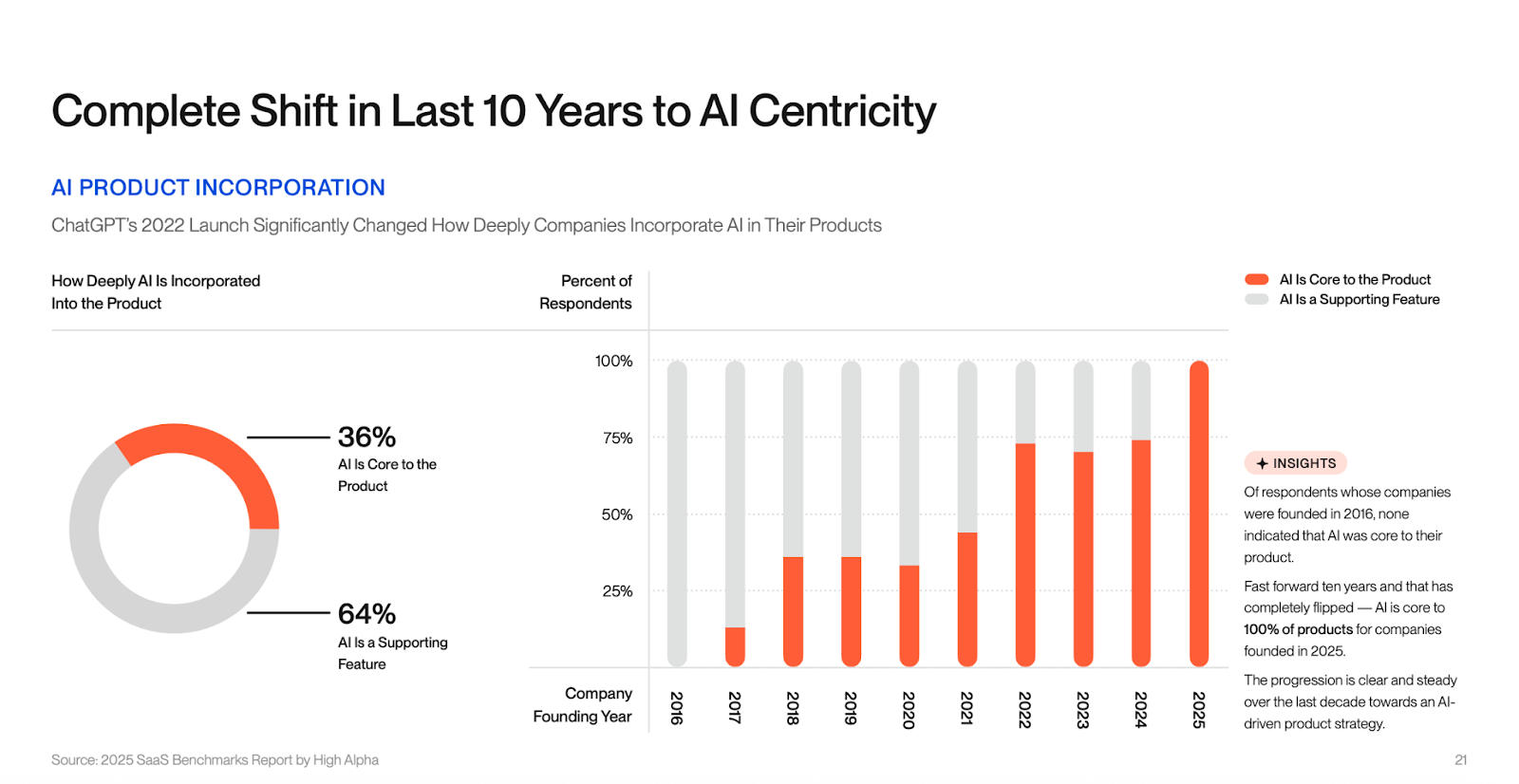
According to the 2025 SaaS Benchmarks Report, about one third of respondents noted that AI is core to their product — they’re AI-native companies. On the surface level, that means that the majority of SaaS companies today are merely using AI as an enabling or supporting feature. But when you look at percentage of AI-native vs. AI-enabled companies by founding year, you’ll see a distinct trend towards AI centricity.
100% of companies founded in 2025 reported that they are AI-native, vs. 0% of companies founded in 2016. We also see a big jump from 2021 to 2022 due to the release of ChatGPT — in 2021, the majority of companies were not AI-native, but in 2022, that number flips with the majority of companies reporting AI-native products.
If you’re building a product today, it’s likely that AI will be at the core of it. And that’s probably to your advantage.
AI-Native Companies Grow Faster Than Peers Across All ARR Cohorts
Yep, it pays to be AI-native.
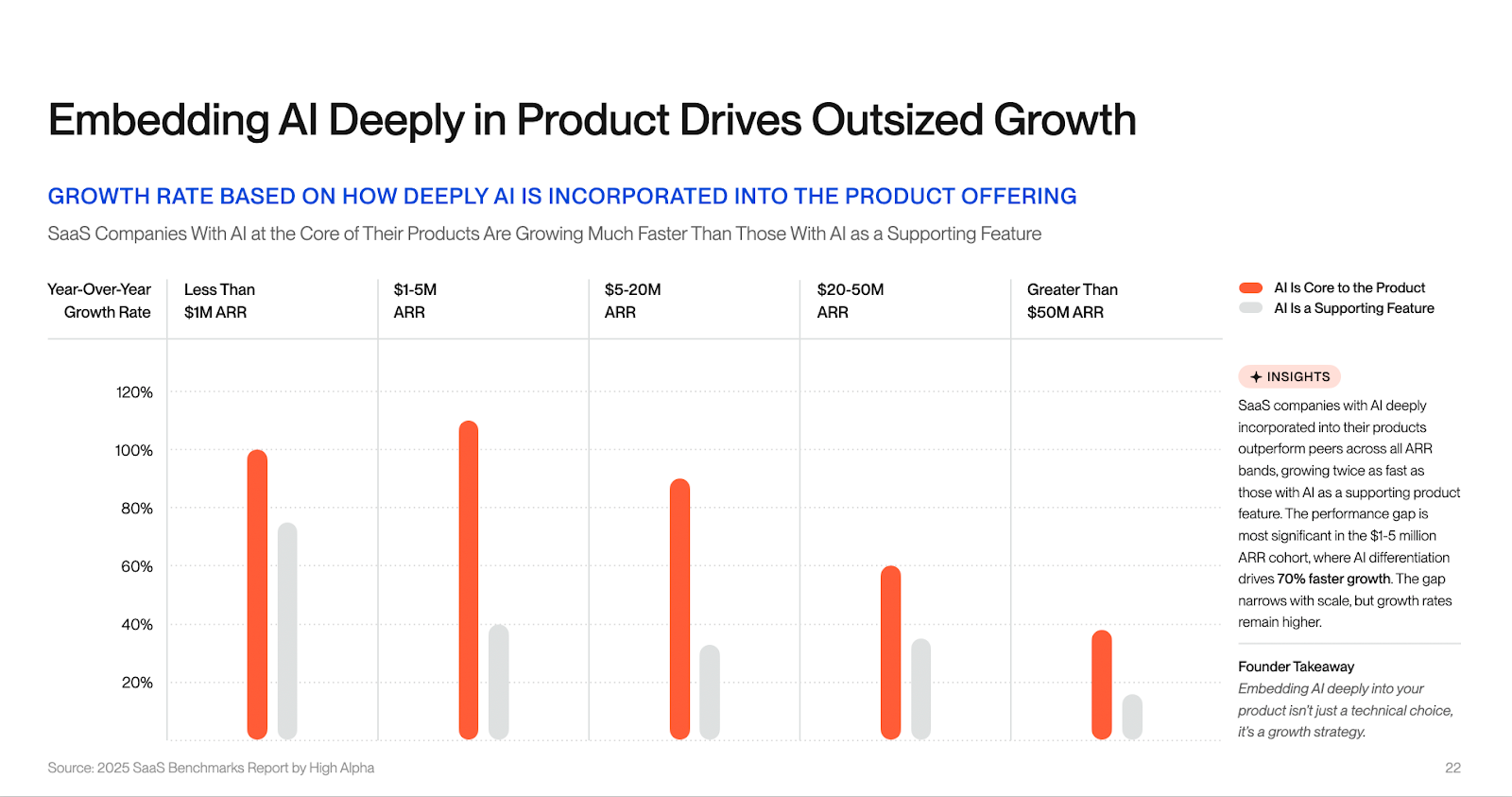
According to our data from the 2025 SaaS Benchmarks Report, growth rates are higher across all ARR bands for AI-native companies vs those that are simply adding on AI features — 100% vs 75% year-over-year growth (Less Than $1M ARR), 110% vs. 40% year-over-year growth ($1-5M ARR), 90% vs. 33% year-over-year growth ($5-20M ARR), 60% vs. 35% year-over-year growth ($20-50M ARR), and 38% vs 16% year-over-year growth (Greater Than $50M ARR) respectively.
As you know, there’s more to the story than simply growth rates. Which is why we also broke down AI-native vs. AI-enabled company benchmarks in other SaaS metrics to see where the tradeoffs are occurring.
Software Gross Margins Are Worse for AI-Native Companies, But It Doesn’t Really Matter
We looked at growth rates, software gross margins, and Rule of 40 for AI-native and AI-enabled companies, which tells us a bit more about how AI-native companies are different from their traditional SaaS peers.
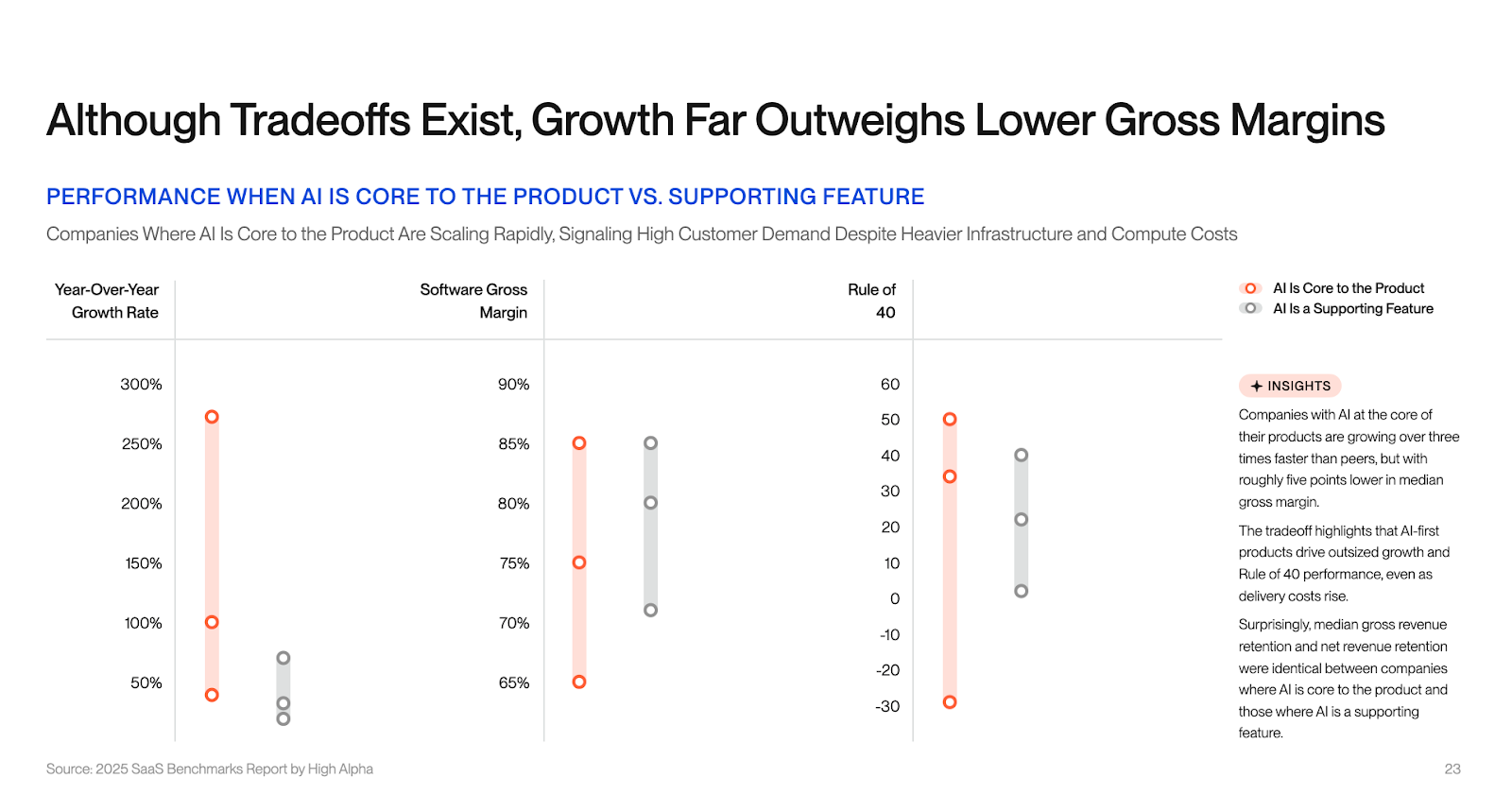
If you’re an AI-enabled company, it’s likely that your software gross margins are better — median software gross margins for AI-enabled companies are 80% compared to 75% for AI-native companies. But when you compare Rule of 40, a metric that helps evaluate a company's overall health and sustainability, the median for AI-native companies is 34% compared to 22%.
So while software gross margins are better for AI-enabled companies, the growth more than makes up for it.
Practical Advice for Early-Stage Founders
AI is not going anywhere. Whether you’re getting ready to launch your MVP this year, or you’ve been building for a while now, here’s what you need to keep in mind when incorporating AI into your product.
1. Integrate Deeply, Early
Don't wait until product-market fit is fully established to think about AI as more than a feature. Consider how AI can redefine your core value proposition and user workflows. This might involve building custom models, leveraging advanced APIs, and designing data architectures specifically for AI.
If you have a legacy product that’s not built on AI, avoid a complete rebuild and instead focus on strategic re-architecture. This could look like incorporating intelligent workflows around your core product, rethinking or testing the user experience, and cleaning up infrastructure to support true AI functionality.
2. Embrace Gross Margin Tradeoffs
Building AI-native solutions can come with higher initial compute costs or require more specialized talent, potentially impacting early gross margins. View this as an investment. The growth outweighs these initial tradeoffs. AI-native companies are different from traditional SaaS companies — treat them as such, while keeping an eye on both costs and growth.
3. Hire for AI Fluency
Your team needs to think and speak AI. While this does apply to engineers building your product, it’s also about hiring AI fluent talent across departments ranging from product and customer success to marketing and sales. When hiring your dream team, consider asking how they’re using AI in their roles to expand their own capabilities.
4. Data as a Strategic Asset
An AI-native approach necessitates a robust data strategy. How will you collect, store, clean, and leverage data to continuously train and improve your AI models? This foundational work is critical.
If You Can’t Beat Them, Join the Movement
For early-stage founders, this isn't a call to simply add more AI features, but to reimagine the very fabric of your product through the lens of AI. The data (download here!) shows AI companies are growing faster while maintaining a higher median Rule of 40 — and embracing AI now will be imperative for companies to grow and scale over the next decade.
