

For early-stage B2B SaaS founders, fundraising is often an inescapable, and at times, all-consuming part of the journey. While building and deploying your product and acquiring customers are paramount, securing the capital to fuel that growth frequently demands an equivalent, if not greater, share of a founder's attention.
What many new founders often underestimate, however, is the sheer duration and intensity of the fundraising process.
As a team of former operators, we know that fundraising can be a grind. So we gathered data to see just how long it takes SaaS founders to raise capital, and what the success rate looks like.
Here’s what we found.
The Reality of the Fundraising Timeline for SaaS Founders
Gone are the days of quick, serendipitous closes (if they ever truly existed for most). Current data indicates that founders should brace for a significant time commitment.
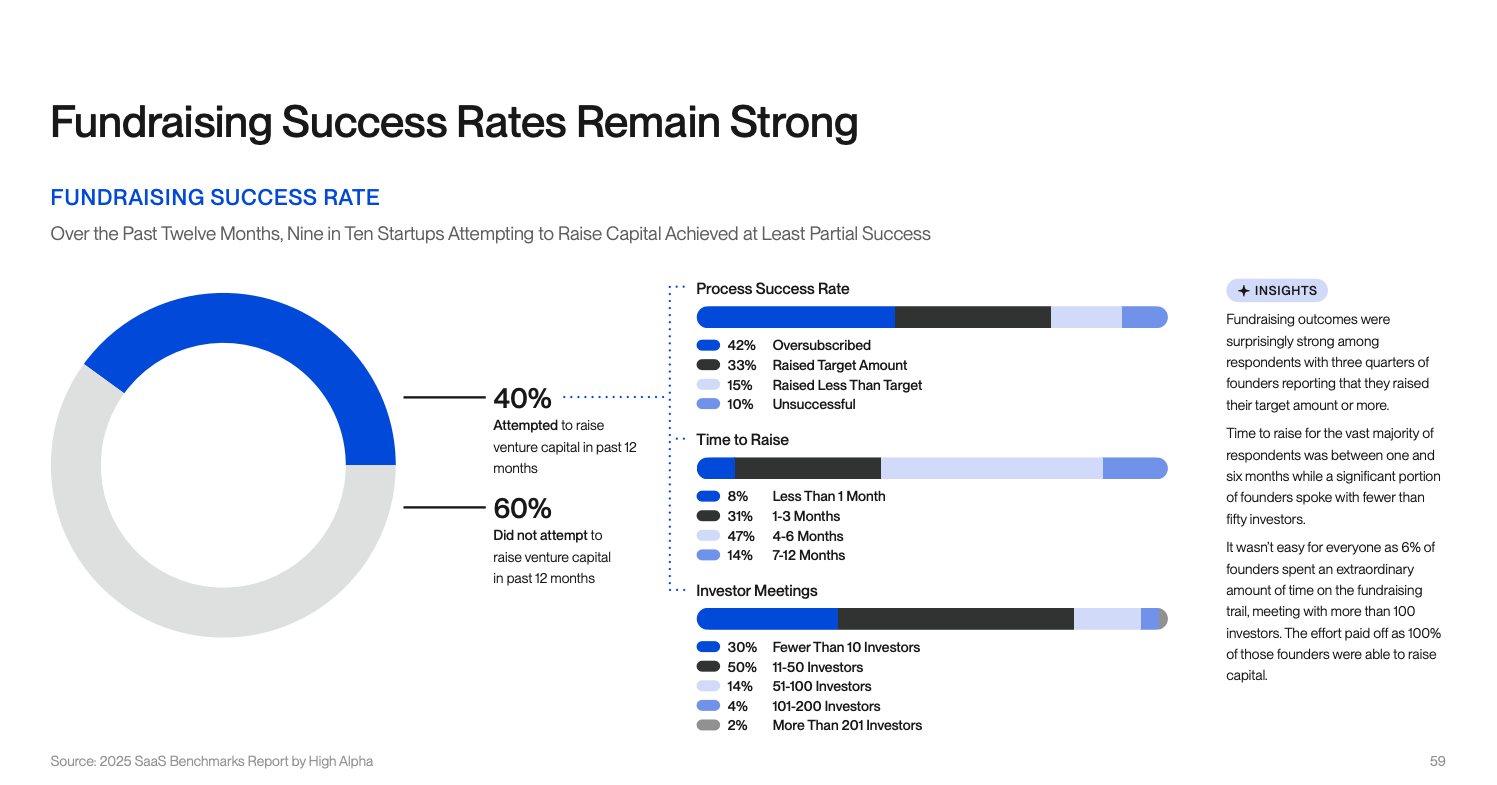
On average, most founders — 47% according to our SaaS Benchmarks — will spend 4-6 months actively raising a funding round. 31% of SaaS founders reported spending 1-3 months, 8% said it took them less than a month (great news for those folks!), and 14% said it took them 7-12 months.
Unless you’re part of the 8% who were able to raise a round in less than a month, fundraising isn't just a casual side project; it's a full-time endeavor that runs in parallel with leading your company.
This extended timeline underscores the importance of proper planning, managing burn rate, and ensuring your existing team can operate effectively while you're deep in investor conversations.
The Investor Gauntlet: Quality Over Quantity, But Prepare for Both
So you’ve planned your timeline, but how many investors should you meet with? According to our data above, the bulk of founders meet with under 50 — half of founders met with between 11 and 50 investors, and a third of founders met with fewer than ten investors.
On the flip side, 14% of founders reported meeting with 51-100 investors, 4% said they met with 101-200 investors, and 2% of founders said they met with over 200 investors!
This wide range highlights the varied nature of fundraising — what appears straightforward for some founders is a much more extensive journey for others. Our guess? Those who reported meeting with fewer investors likely kept relationships warm — sending company updates to a small group of trusted investors who were aware of company momentum and fundraising timeline.
Beyond building relationships when you’re “not fundraising”, stellar benchmarks and incredible growth also make fundraising more successful (but no less stressful!). Companies that are growing quickly, serving a large market, and that have a unique wedge or competitive advantage spark interest from investors. Understanding where you stack up compared to others is important — and one of the reasons we spend time gathering annual data for our SaaS Benchmarks! Companies that are true outliers typically get term sheets quickly — which in turn tends to incentivize other investors to follow suit. This can be frustrating for a founder seeking their first term sheet, so our recommendation is to focus on the controllables: refining your message, understanding investor types, and being prepared to articulate your vision, market, and traction numerous times. After all, each meeting is an opportunity to learn, adapt, and improve your approach.
A High Rate of Success for the Persistent
Despite the perceived challenges and the time investment, there's a reassuring statistic for those embarking on this path: 75% of founders reported raising either at their target amount or raising an oversubscribed round! Meanwhile, 15% of founders reported raising capital under their intended target, and 10% of founders said they were unsuccessful in their fundraising efforts.
With 90% of founders reporting raising some type of round, this figure is a powerful testament to the fact that if you have a compelling product, a clear vision for building a venture-scalable business, and some momentum, the odds are firmly in your favor.
Key Tips for Founders Navigating the 2026 Fundraising Landscape
Raising money in 2026? In our experience, these things help:
1. Nail Your Pitch (and Constantly Refine It)
Your pitch deck is your story, and your verbal delivery is its heartbeat. It needs to be clear, concise, compelling, and backed by data. Practice relentlessly, get feedback, and be ready to adapt it based on the investor's focus and questions. Understand the problem you're solving, your unique solution, market size, business model, team, and traction cold.
Lastly, be able to vouch for yourself — why are you the right person to solve this problem and build this business? This goes a long way.
2. Understand the Timeline and Dial In
Don't start fundraising when you're about to run out of cash. Begin the process with a comfortable runway (ideally 9-12 months) to avoid desperation and allow for the average 4-6 month timeline. Dedicate significant blocks of your time to outreach, meetings, and follow-ups. This is not something to dabble in; it requires focus.
3. Leverage Your Network (Strategically)
Warm introductions are gold. Spend time cultivating relationships with other founders, advisors, and angels who can make introductions to relevant investors.
4. Know Your Numbers — and AI Storyline — Inside Out
Beyond just your pitch, be ready to dive deep into your financials, unit economics, customer acquisition costs, churn rates, and growth projections. Investors want to see a founder who understands the levers of their business. Again, this is where benchmarks can be helpful. Not only can they show you how you stack up against similar companies, but they can also reveal areas of strength and weakness.
Additionally, be ready to answer the inevitable questions around AI. If you’re an AI-native startup, you’ll need to defend the moat you’re building. Be ready for questions like, “why can’t the tech giants build what you’re building?”. If you’re not an AI-native startup, be ready to answer questions about how you’re using AI to deliver faster and with fewer resources.
5. Be Prepared for Due Diligence
As conversations progress, investors will ask for more data, legal documents, and detailed financial models. Having these organized and ready will streamline the process and demonstrate that you know what you're doing.
6. Manage Your Emotional Bandwidth
Fundraising is a marathon, not a sprint. There will be rejections, delays, and moments of doubt. Build a support system and remember why you started.
Wrapping It Up
Fundraising in 2026, much like any year, is a challenging but ultimately rewarding journey for many founders. By understanding the data — the time commitment, the investor engagement, and the strong success rate for those who persevere — you can approach the process with greater preparation, resilience, and ultimately, a higher chance of securing the capital needed to build your vision.
