
.png)
If you’re building a SaaS company right now, the pricing and go-to-market decisions you make in 2026 will shape your competitive position for years. AI is no longer a differentiator — it’s the baseline. What separates the companies that win is how they monetize it, prove its value, and integrate into a fast-changing ecosystem. Last year, we published predictions for 2025 grounded in data from our SaaS Benchmarks. Here’s how those predictions held up — and what the data tells us about where early-stage founders should focus in 2026.
1. Companies Will Shift From Generic GTM Focus to Hyper-Personalization
2024 Insight: Unsurprisingly, More SaaS Companies Are Monetizing AI Today Than a Year Ago.
2025 Prediction: GTM Strategy Will Become a Major Focus.
Recap: Right.
The initial scramble to integrate AI gave way to a concerted effort to articulate its value. As AI-native companies continue to grow faster on average than traditional SaaS companies, the latter will continue to watch, learn, and consider some growing GTM differences between themselves and their AI-native counterparts.
2026 Prediction: Personalized GTM and Hyper-Niche Targeting Will Dominate — But So Will In-Person Events
As AI and AI-native products adoption becomes table stakes, generic go-to-market strategies will falter. The next frontier is leveraging AI itself to inform and execute your GTM. Expect SaaS companies to use AI-driven insights to understand buyer needs at an individual or micro-segment level, tailoring messaging, content, demos, and even product onboarding to hyper-niche segments. The conversation will shift from "our product has AI" to "our AI personalizes your specific outcome in your specific industry by X%”. This means deeper integrations with CRM data, intent signals, and AI-powered content generation for highly relevant outreach.
At the same time, as buyers become inundated with digital noise, in-person events will be a GTM top channel in 2026 for AI-native and SaaS companies alike.
What this means for early-stage founders: You don’t need a massive marketing team to execute hyper-personalized GTM — you need a sharp ICP and AI-powered tooling. Before you build out campaigns, audit your CRM data to see if you can segment by industry, use case, and outcome. If you can’t, fix that first. On the in-person front: even one well-chosen regional event per quarter can punch above its weight for early pipeline if you’re ruthless about pre-scheduling meetings and following up within 24 hours.
2. Beyond Subscription: The Rise of Value-Based Tiers
2025 Insight: Most Early Stage SaaS Companies Are Still Monetizing AI Via a Subscription-Based Model.
2025 Prediction: For Early Stage SaaS, Subscription Pricing Will Still Play a Large Part (for Now).
Recap: Mostly Right.
Subscription models remain the bedrock of SaaS, and early-stage companies largely stuck to this familiar path for their AI features. However, "for now" proved prescient. Customers are increasingly scrutinizing the value derived from fixed subscriptions for AI, especially when usage varies or the direct impact isn't immediately clear. The pure subscription model, while simple, sometimes struggles to capture the variable value AI can deliver.
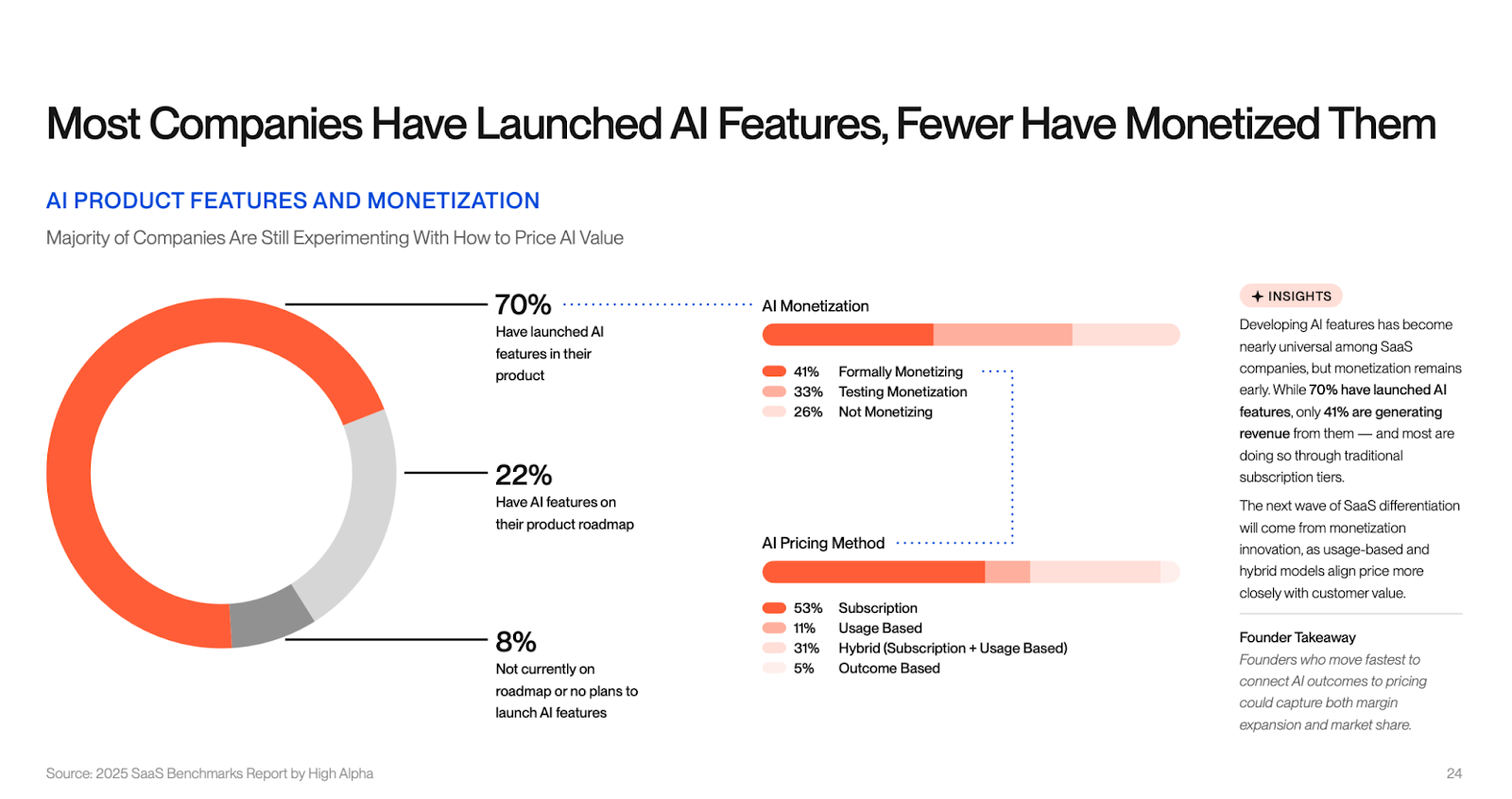
Data from our 2025 SaaS Benchmarks showed that 53% of companies monetizing AI are still adopting a subscription based pricing model. Hybrid monetization strategies followed behind at 31% of companies. Only 11% of companies monetizing AI are using pure usage-based models, and only 5% are using pure outcome-based pricing models.
2026 Prediction: Hybrid Models Will Emerge as the Standard
While the subscription won't vanish, expect a significant surge in hybrid pricing models. This will involve a foundational subscription fee combined with consumption-based or outcome-based add ons for AI usage (e.g., per inference, per complex query, per generated output exceeding a baseline).
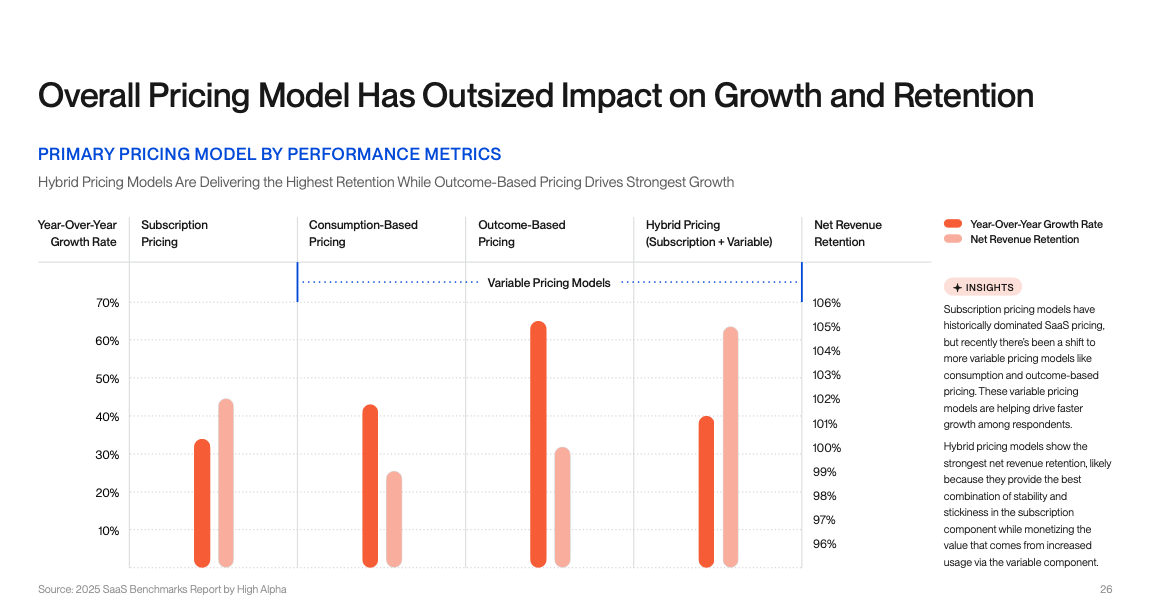
Per our own data, hybrid pricing resulted in the highest median net revenue retention (NRR) across SaaS companies at 105%. And while companies' adoption of outcome-based pricing and consumption-based pricing showed the highest year-over-year median growth rates at 65% and 43% respectively, it might take a few years for companies to fully adopt these newer pricing models.
What this means for early-stage founders: If you’re under $5M ARR, the data gives you permission to stay subscription-heavy — but it also gives you a clear mandate: start instrumenting usage now. Track which features are driving value, how often customers are hitting usage ceilings, and where AI delivers measurable outcomes. You’ll need that data to design your hybrid tier when the time comes. And that time will come faster than you think: our data shows hybrid models generate a median NRR of 105%, which is a meaningful difference in a renewal conversation.
3. Large SaaS Innovates, Early Stage Leapfrogs
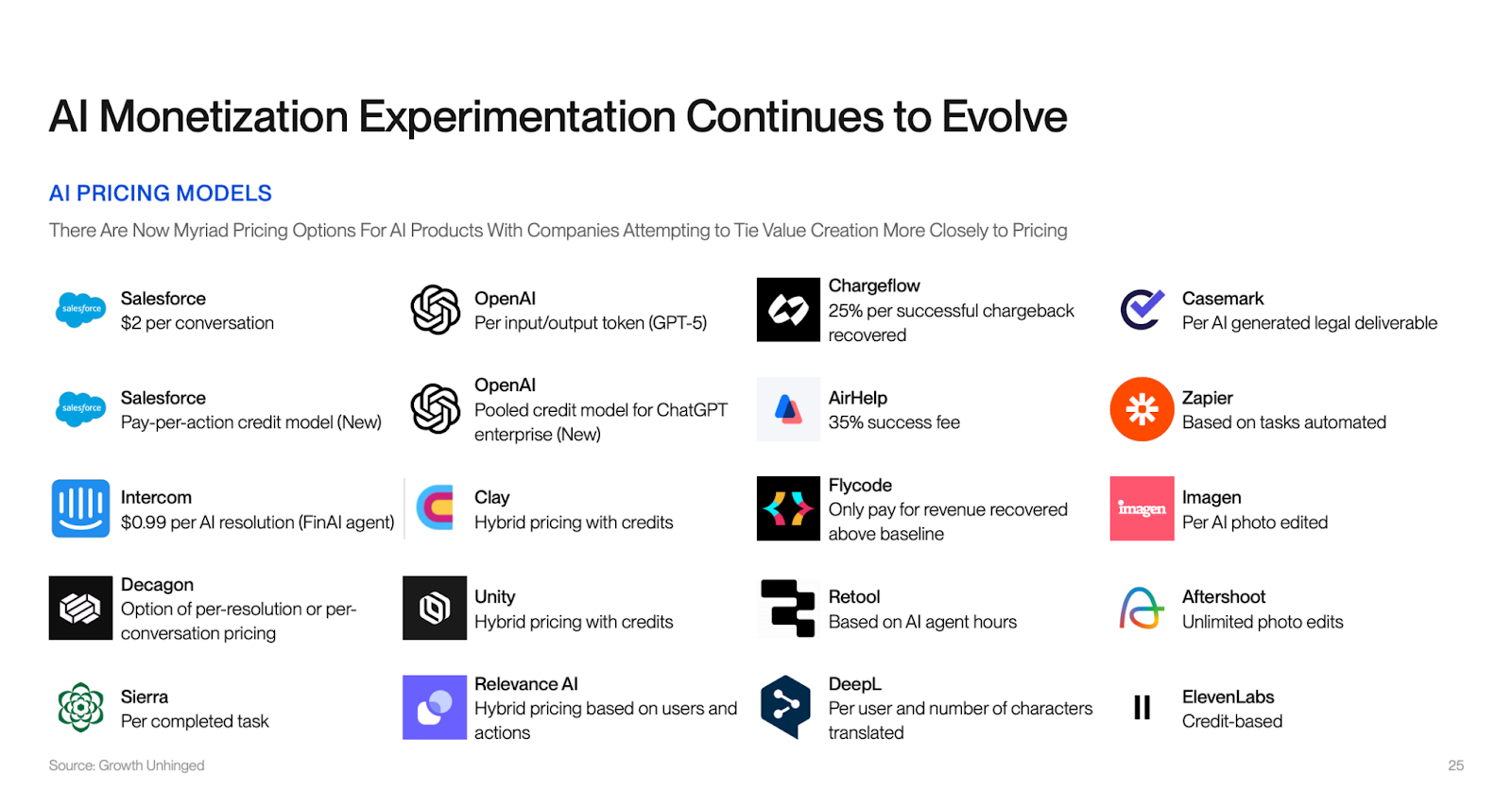
2025 Insight: There’s a Lot of Pricing Experimentation Happening.
2025 Prediction: For Early Stage SaaS, Large SaaS Will Innovate, Early Stage SaaS Will Follow.
Recap: Largely Right.
Larger SaaS players (along with their extensive resources, larger customer bases, and data analytics capabilities), led the charge in experimenting with more complex consumption and outcome-based pricing models. They have the luxury of testing different approaches without existential risk.
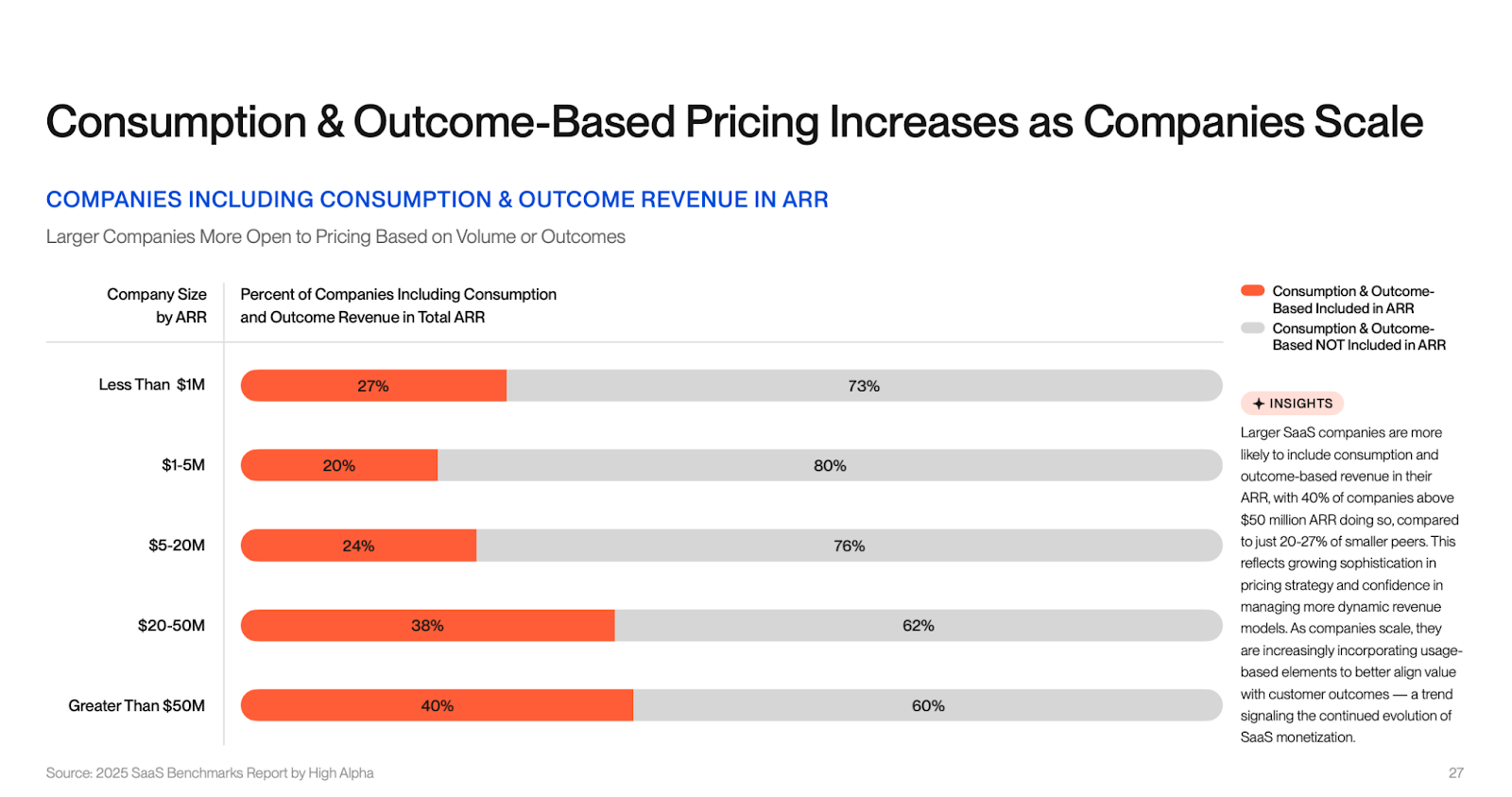
For companies greater than $50 million ARR, 40% reported including consumption and outcome based revenue in their total ARR. 38% of companies in the $20 to $50 million ARR cohort reported consumption and outcome based revenue in total ARR. This percentage drops in the earlier stages, down to 20% of companies in the $1 to $5 million ARR range, and 24% of companies in the $5 to $20 million ARR range. Finally, the earliest stages, those with less than $1 million ARR, actually reported slightly higher rates of consumption and outcome based ARR at 27% of companies.
2026 Prediction: Early Stage SaaS Will Leapfrog with Outcome-Based Pricing for Niche Problems
While larger companies continue to pioneer, early-stage SaaS targeting highly specific, high-value problems will find success by directly linking pricing to outcomes. They won't just "follow" but will adapt and innovate within their specific niches, often demonstrating superior agility.
Those in the middle area — $1 million to $20 million in ARR — will struggle the most to quickly adopt experimental pricing as their focus is largely on scaling.
What this means for early-stage founders: The data reveals a counterintuitive opportunity: the very earliest companies (pre-$1M ARR) are experimenting with consumption and outcome-based models at a higher rate than $1–$20M companies. This is the leapfrog moment. If you’re pre-revenue or early-revenue, you have no legacy pricing to protect — design your model around outcomes from the start. If you’re in the $1–$20M range and locked into subscriptions, ask yourself: what one AI-specific workflow can you isolate, measure, and begin pricing differently? You don’t need to overhaul your entire model overnight; you need a wedge.
4. Proving Value: The New Demo
2025 Insight: AI Features and Products Are Formalizing.
2025 Prediction: Buyers Will Start to Value AI Features Differently.
Recap: Absolutely Right.
This was a somewhat obvious prediction, but nevertheless it’s turned out to be true. The initial "wow factor" of simply having "AI" in a product has completely evaporated. Buyers are no longer impressed by generic AI claims. Instead, they scrutinize AI capabilities for tangible ROI, measurable impact, and how effectively the AI solves their specific, real-world problems. The demand is for clarity, transparency, and demonstrable results, not just buzzwords.
2026 Prediction: Proof of Value (PoV) Becomes the New Demo
Generic demos showcasing AI capabilities in a vacuum will no longer suffice. Mini-implementations and pilot projects that demonstrate the AI’s efficacy within their specific data, workflows, and business context will become the norm. SaaS companies will need highly capable onboarding, customer success, and solution engineering teams adept at quickly proving quantifiable value. The sales cycle will shift from feature showcase to an empirical validation of impact, requiring deeper partnerships and more customized pre-sales engagements.
What this means for early-stage founders: Early-stage founders actually have a natural advantage here — you can personally run a tight PoV engagement in a way a 500-person company cannot. Build a repeatable PoV playbook early: a defined 2–4 week pilot scope, a clear success metric agreed upon before the engagement starts, and a structured readout that translates AI activity into business outcomes. This becomes your most powerful sales asset, and it compounds as you accumulate proof points across customer types. Hire for this capability early; don’t assume traditional AEs can run technical validation engagements without support.
5. From Arms Race to Specialized Collaboration
2025 Insight: We’re in an AI Agent Arms Race.
2025 Prediction: Every Large SaaS Company Will Launch an AI Agent.
Recap: Mostly Right.
Indeed, many large SaaS companies rushed to launch or integrate AI agents into their platforms. The initial 'arms race' was palpable, leading to a crowded market of general-purpose agents (not just chatbots).
What’s notable isn’t that these giants launched agents — that was inevitable given their R&D budgets and customer base pressure. What’s more instructive for early-stage founders is what happened next: the market quickly fragmented into a mass of overlapping, general-purpose agents that buyers couldn’t distinguish or prioritize. The crowding created an opening. Purpose-built agents targeting a specific workflow in a specific vertical — claims processing in insurance, SOW generation in professional services, inventory reordering in CPG — outperformed broad horizontal agents on both adoption and customer satisfaction. The arms race produced generalists. The opportunity is in the specialists.
2026 Prediction: The Rise of Agentic Interoperability and Agent Orchestration
In 2026, the focus will pivot from 'Who has the best agent?' to 'How well do your agents play with others?'
We are entering the era of agentic interoperability. Buyers are realizing they don't want 50 siloed agents; they want a cohesive ecosystem. Expect to see the wide adoption of open standards like the Model Context Protocol (MCP), which allows agents from different vendors to securely share data and execute tasks across platforms.
The 'winner' in 2026 won’t be the company with the flashiest standalone agent, but the one that acts as the orchestrator. We will see the rise of 'Manager Agents' — centralized AI layers that can delegate a task to a Salesforce agent, verify it with a Zendesk agent, and then report the outcome in Slack. The conversation will move from individual automation to connected intelligence, where the value is found in the seamless handoff between specialized AI 'colleagues' across the entire SaaS stack.
What this means for early-stage founders: Don’t build a horizontal agent competing with Salesforce or ServiceNow. Build the specialist agent that those platforms will want to plug into. The rise of MCP and agent orchestration frameworks is your friend — it means large platforms need best-in-class, narrow agents, not just their own mediocre generalists. Position yourself as the most trustworthy, most accurate agent for one specific workflow, and design your product from day one to be interoperable. Being “the agent that works seamlessly inside [dominant platform]” is a more defensible and acquirable position than trying to be a standalone platform yourself.
The Road Ahead
2026 is the year AI stops being a story and starts being a scorecard. The founders who will look back on this period as their inflection point are not the ones who moved fastest to ship an AI feature — they’re the ones who made deliberate decisions about pricing architecture, sales motion, and product positioning before the market forced their hand. The benchmark data is clear: early-stage companies that instrument usage, design for composability, and prove value empirically are pulling ahead of those still leading with capability narratives. The question for you isn’t whether AI matters to your company. It’s whether your company is set up to prove that it matters to your customers.
