

Over the past few years, there’s been a massive push to incorporate AI into software products. And while AI product strategy is certainly still on the top of agendas for SaaS companies, there’s a new priority in town: Operation AI. Or, how do we get everyone on our team to use AI so that we, as a company, can be more productive and efficient.
According to the 2025 SaaS Benchmarks Report, 78% of founders reported that, over the past 12 months, internal adoption of AI is either “strongly encouraged” or a “strategic priority” for their teams. We’ve gone beyond simply deploying AI tools — now, it’s about embedding intelligence into the operational DNA and culture of your company.
But, spoiler, a lot of measuring impact is based on vibes.
A Continued Shift Towards Efficiency
As the market enters what we’re calling a “steady state growth era”, efficiency metrics are back in vogue. Not only are companies shying away from growth at all costs, but efficiency metrics like ARR per employee continue to rise. This reflects a broader trend of companies becoming significantly more efficient, and/or course correcting from the highs of 2021.
This isn’t just something we’re observing — we see it in the data, too. For SaaS companies with $5-20 million ARR, median employee count has dropped 25% in 2025 since 2022, from 88 to 66 employees. In the $20-50 million ARR cohort, that decrease is 42%, from 226 to 131 employees. And for SaaS companies with $50+ million ARR, we’re seeing the biggest decrease in team size: median employees dropped 59% in 2025 compared to 2022, from 876 to 361 employees.
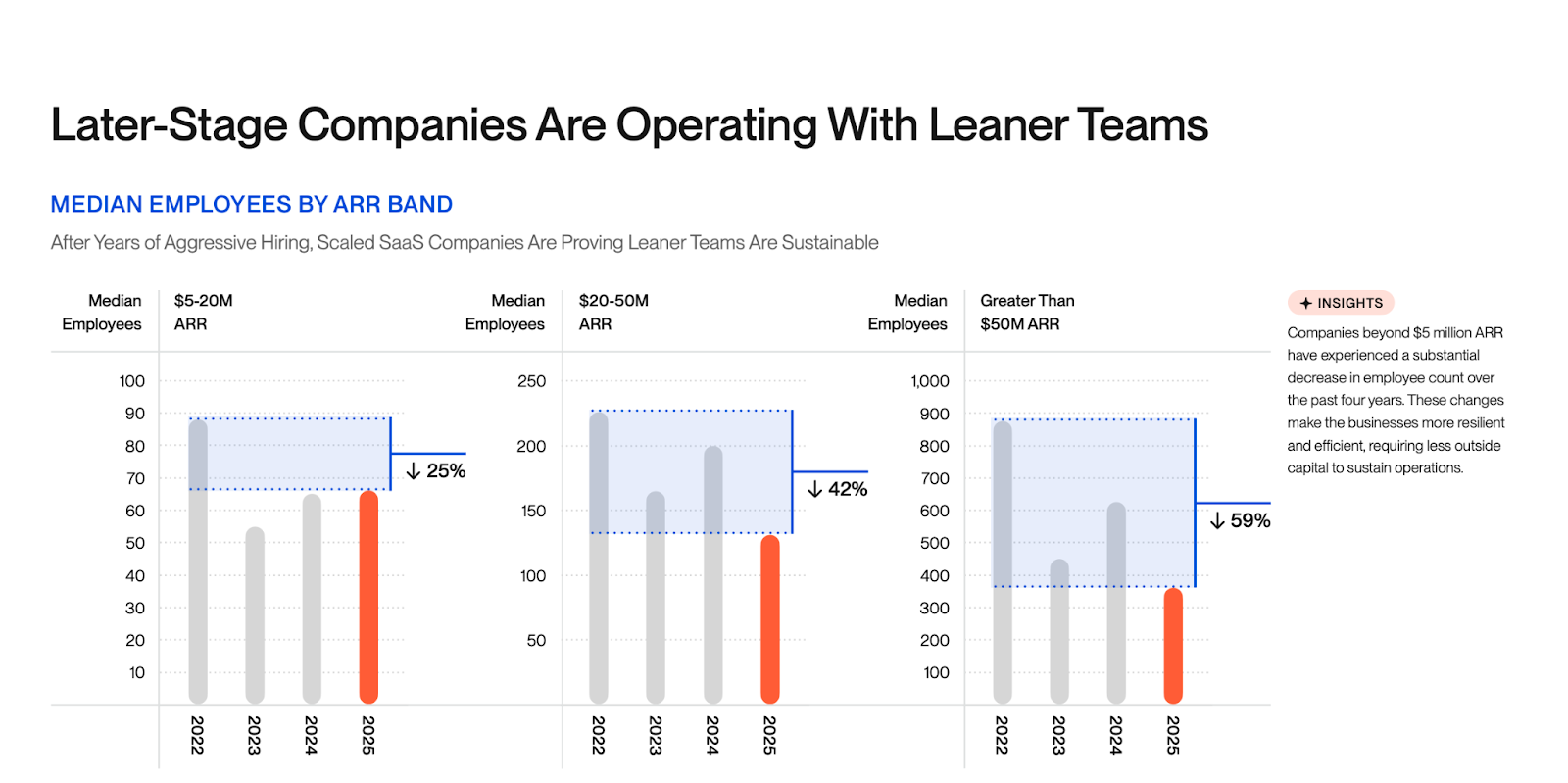
The promise of AI has always been increased productivity. This promise paired with a fundamental shift towards efficiency (as seen in prioritizing Rule of 40, ARR per employee, etc.) is spurring Operation AI and the encouragement of adopting AI internally.
I chatted with a marketer in our portfolio recently who used AI to generate original music for their funding announcement video, saving their team time (they simply prompted an LLM and provided creative direction) and money (no licensing fees!). This is a small, small example, but it’s how founders want their employees to be thinking: what’s possible with AI now that wasn’t five years ago, and how do we use this to save time, money, and resources?
AI Is Fueling the Do-Less-With-More Mindset
Companies are expecting to do more with less. And in many cases, this is represented by department headcount.
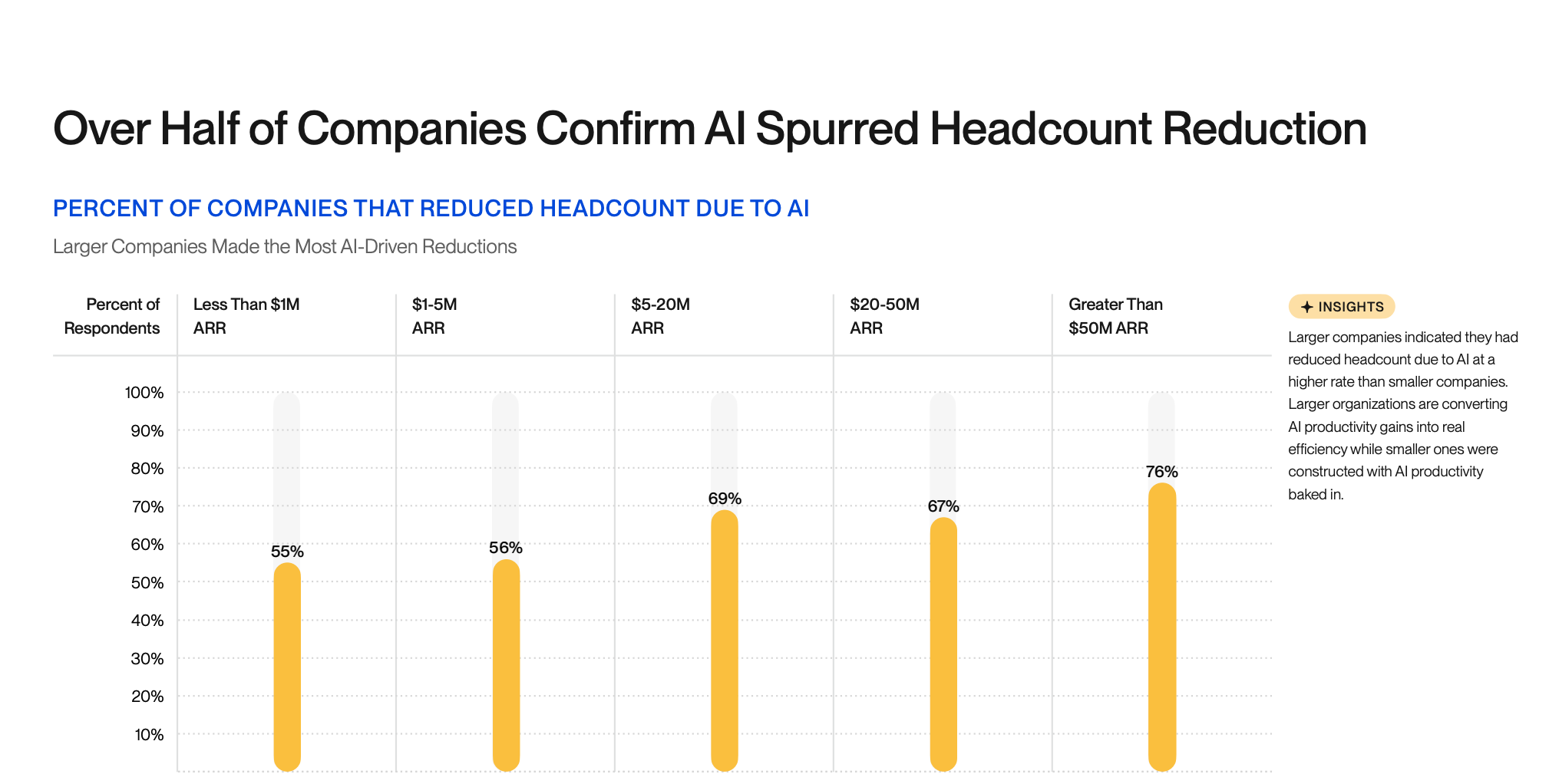
Across all ARR cohorts, over half of companies indicated that they had reduced headcount over the past year due to AI. That’s 55% of companies with <$1 million ARR, 56% of companies $1-5 million ARR, 69% of companies $5-20 million ARR, 67% of companies $20-50 million ARR, and an outstanding 76% of companies >$50 million ARR.
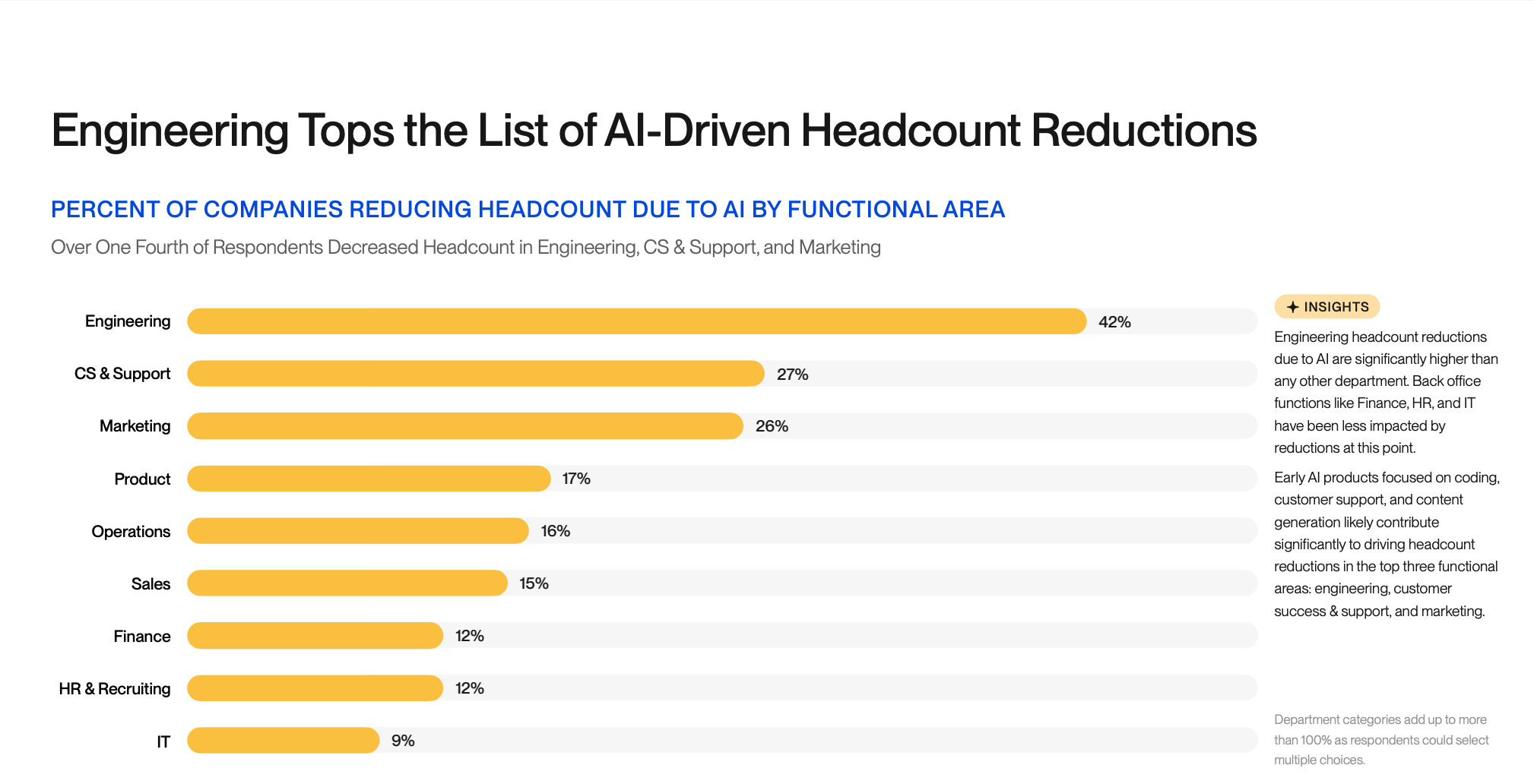
When asked to note specific departments where companies have reduced headcount over the past 12 months due to AI, the data falls in line with other stories we’ve seen: Engineering and Customer Service and Support are getting hit the hardest.
Our data shows that for companies across all ARR bands, Engineering was the most likely department to have reductions due to AI (42% of companies), followed by Customer Service and Support (27% of companies) and Marketing (26% of companies). There was a large gap from there, with Product, Operations, and Sales only reporting 17%, 16%, and 15% of companies respectively. Finance, HR and Recruiting, and IT all appear safe — at least for now.
Internal Adoption of AI Is a Priority, But Measuring It Is All Vibes
The push for employees to adopt AI is not a fleeting trend. SaaS companies are operating with leaner teams, encouraging adoption of AI internally, and reducing headcount because of AI efficiency gains (real or perceived).
However, here's where the "vibes" come in.
Despite the strong push for adoption, the measurement of internal AI impact is still largely qualitative. This presents an interesting dichotomy. On one hand, 44% of respondents confidently state that AI has "significantly improved" or "revolutionized" their teams’ efficiency. On the other, the methods for quantifying this revolution often feel elusive, relying heavily on anecdotal evidence and perceived improvements rather than concrete metrics. In fact, fewer than 25% of companies monitor KPIs or have analytics dashboards to measure AI internal impact.
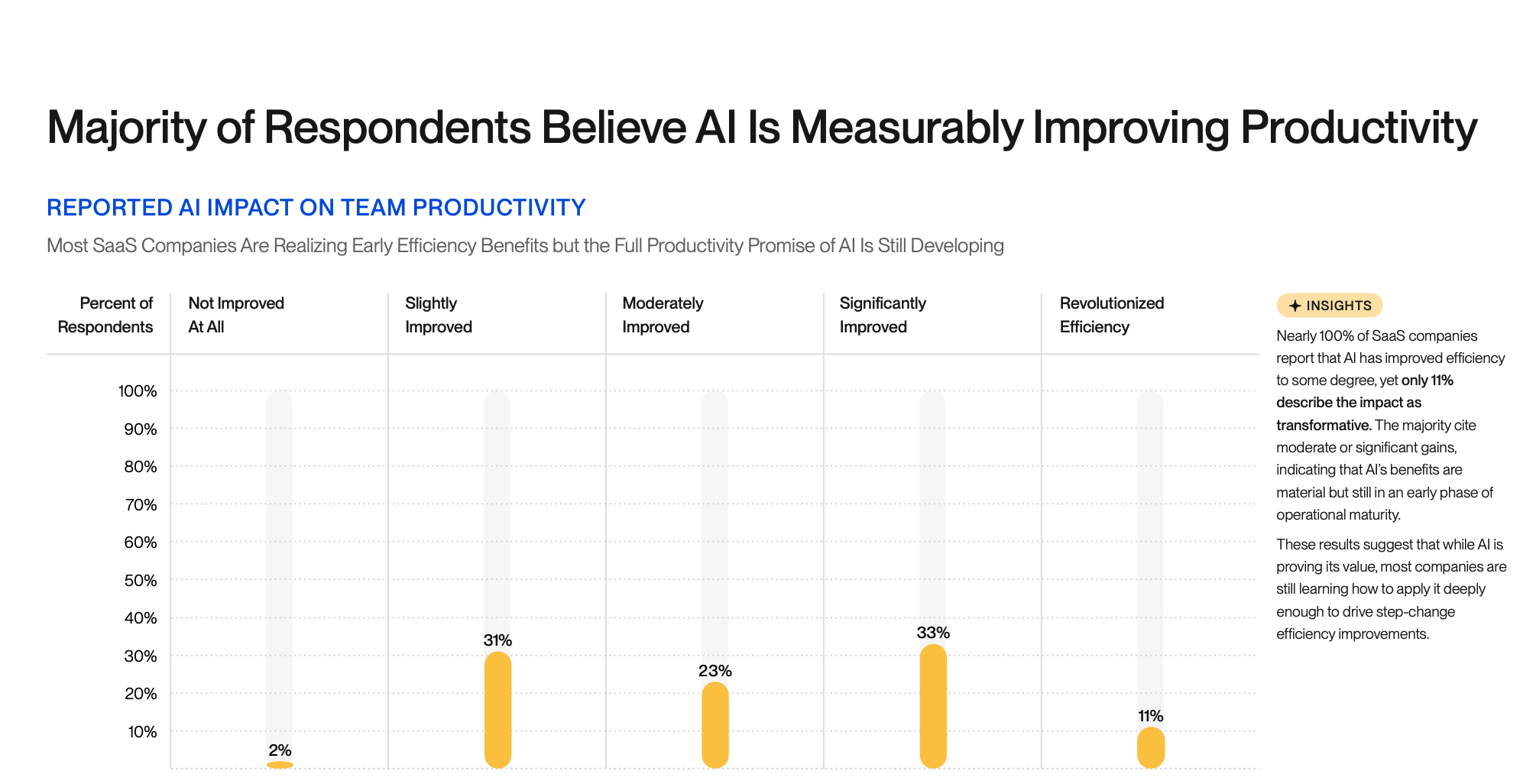
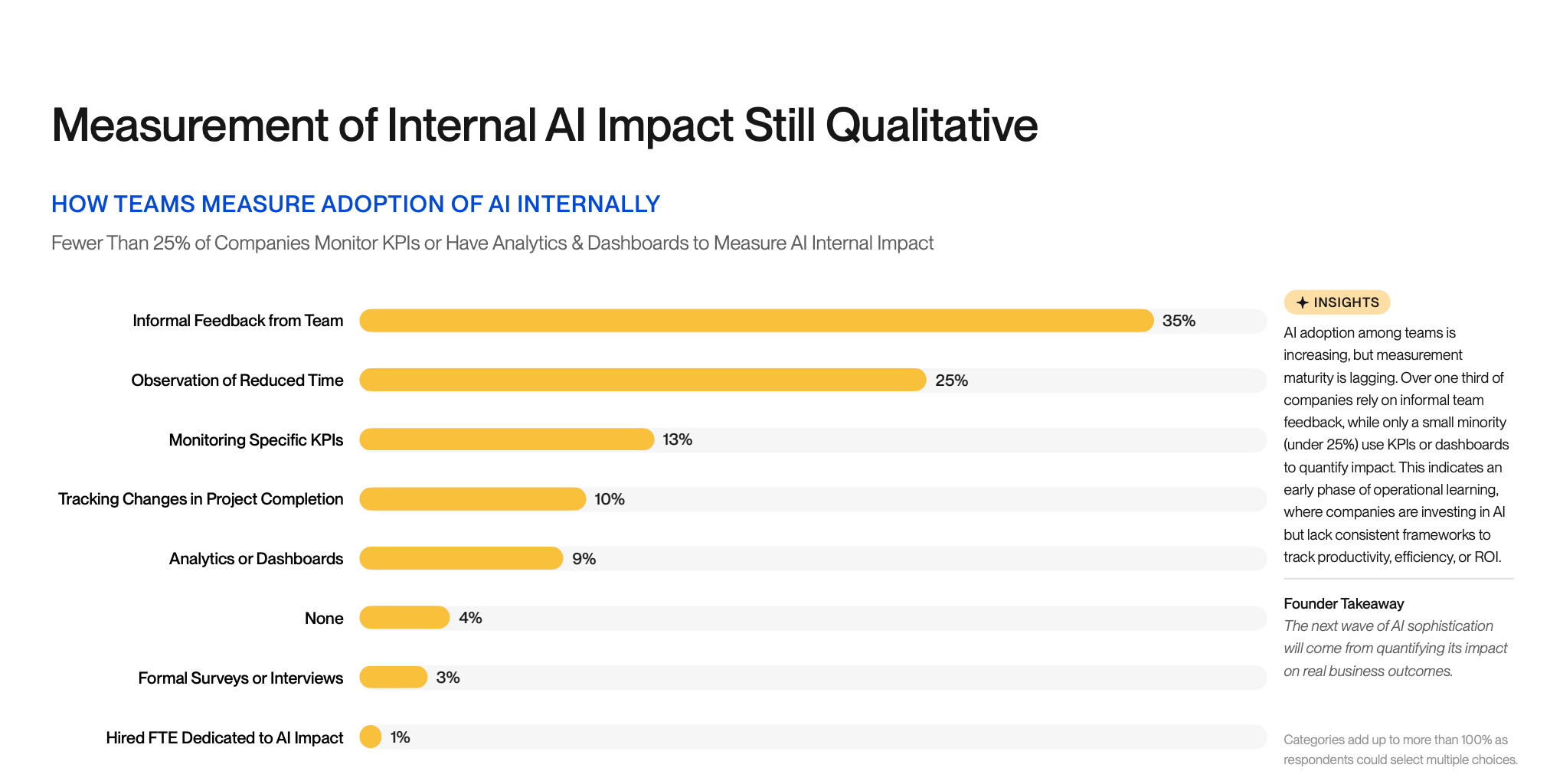
The risk, of course, is that companies place bets on AI — reducing headcount, incentivizing use, spending money on AI-powered software — and that AI impact is unclear. Or, the impact is episodic.
Going back to my earlier example, a team was able to create a song using AI. At that moment, AI feels incredibly powerful. But scaling that power across an entire organization — and all the data cleaning, teaching, etc. that comes with being AI-ready — is much more difficult to imagine. So while we might be in the early innings of measuring AI adoption internally, capturing the impact quantitatively is just one small piece of the puzzle.
Operation AI in 2026
Is there room for improvement in how companies measure AI internal adoption? Of course. It’s how companies will ultimately understand if their investment in AI ops (and…AI-powered software) is paying off.
But completing the Operation AI mission will take more than sophisticated measurement — empowerment, training, data cleaning, hiring talent that’s comfortable and confident using AI, workflow analysis, and more.
As with most things in life, it’s all easier than it sounds.
For more AI data, check out the 2025 SaaS Benchmarks Report!
